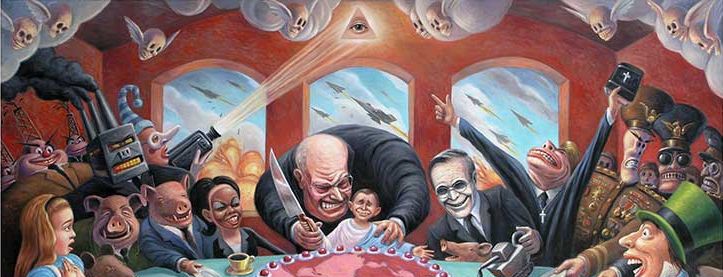
The ‘suicidal state’ and the war on youth

by Henry A. Giroux In spite of being discredited by the economic recession of 2008, market fundamentalism has once again assumed primacy as a dominant force for producing unprecedented inequalities in wealth and income, runaway environmental devastation, egregious amounts of human suffering and what Alex Honneth has called an “abyss of failed sociality.”(1) The Gilded Age is back with big profits for the ultra-rich and large financial institutions and increasing impoverishment and misery for the middle and working class. Political illiteracy and religious fundamentalism have cornered the market on populist rage providing support for a country in which, as Robert … Continue reading The ‘suicidal state’ and the war on youth

Another way is possible

by Kieran Allen The Wall Street Crash of 2008 destroyed an estimated €50 trillion of the world’s assets, which is equal to one year of the combined labour of humanity. As a direct consequence, millions of children face the prospect of ‘long-term irreversible cognitive damage’, according to Patrick Montjourides, from the UNESCO’s Global Monitoring Report team. Rising food prices and growing unemployment have already led to the death of between 200,000 and 500,000 children and many more will suffer brain damage in future due to malnutrition. Yet many still claim that there can be no alternatives to capitalism. ‘We cannot … Continue reading Another way is possible

The capitalist life crisis

by Jeff Noonan The failure of the Durban Conference on Climate Change, (December, 2011) to agree to anything more substantial than that all nations would work together to develop binding targets for reduced greenhouse gas emissions by 2015 is a metonym for the life-crisis besetting globalised capitalism.[1] Because global capitalism subordinates what John McMurtry calls “life-value”  to the expansion and accumulation of  money-value, it progressively undermines the conditions of planetary life-support, human life-requirement satisfaction, and meaningful human life-capacity development and enjoyment.[2]  Resources, relationships, practices, norms, institutions, and forms of life-activity have life-value when they:  a) satisfy objective requirements of human … Continue reading The capitalist life crisis

A Marxian interpretation of the economic crisis

by Stephen Resnick and Richard Wolff Two different and contending mainstream theories have explained capitalism’s repeated crises over the last century. Each time each theory proposed correspondingly different solutions. Today’s crisis is no exception. One theory—called, after one of its founders, “Keynesian economics”—claims that unregulated private markets inevitably yield price movements that react back on the decisions of businesses, workers, and consumers to produce out-of-control price spirals. These periodically push the economy into inflations, recessions, or even depressions. Without intervention from outside, capitalism’s private economy may remain depressed or inflated long enough to threaten capitalism itself. Keynesian—or now more generally … Continue reading A Marxian interpretation of the economic crisis