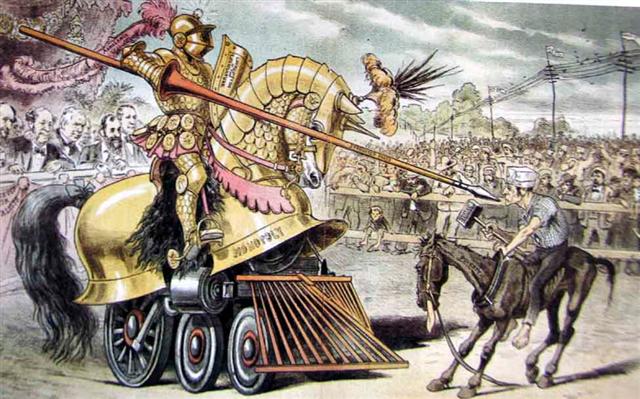
Taking notes 41: Ideological foundations of neoclassical economics: class interests as “economic theory”

by Ismael Hossein-zadeh There is now a widespread consensus that mainstream/neoclassical economists failed miserably to either predict the coming of the 2008 financial implosion, or provide a reasonable explanation when it actually arrived. Not surprisingly, many critics have argued that … Continue reading Taking notes 41: Ideological foundations of neoclassical economics: class interests as “economic theory”

Taking notes 34: The enlightened capitalist

by Shimshon Bichler and Jonathan Nitzan Preamble Over the past few years, we have written a series of articles about the global crisis.[1] These papers try to break the conventional constrains of liberalism and Marxism, examining the crisis from the new theoretical viewpoint of capital as power. Capitalists and corporations, we argue, are driven not to maximize profit, but to ‘beat the average’ and increase their differential power. In this approach, the redistribution of income and assets is not a ‘societal’ side effect of the economy, but the central conflict that propels modern capitalism. And the main weapon in this … Continue reading Taking notes 34: The enlightened capitalist


Sociality, solitude, and the struggle for socialism

by Jeff Noonan The basic principle of historical materialism is that all complex socio-cultural systems and institutions are rooted in and ultimately depend upon reproductive and productive labour. Reproductive and productive labour connect human beings to each other and the sustaining natural environment. “The production of life,” Marx wrote in The German Ideology, “both of one’s own in labour and of fresh life in procreation… appears as two-fold relation: on the one hand, as a natural, on the other, as a social relation—social in the sense that it denotes the cooperation of several individuals.”[1] The second principle of historical materialism … Continue reading Sociality, solitude, and the struggle for socialism