
All my discoveries have been made in answer to prayer. He who thinks half-heartedly will not believe in God; but he who really thinks has to believe in God.—Isaac Newton.
I saw the pale student of unhallowed arts kneeling beside the thing he had put together. I saw the hideous phantasm of a man stretched out, and then, on the working of some powerful engine, show signs of life, and stir with an uneasy, half vital motion. Frightful must it be; for supremely frightful would be the effect of any human endeavour to mock the stupendous mechanism of the Creator of the world.—Mary Shelley, Frankenstein (1831).
by Sanjay Perera
THE great novel by Mary Shelley Frankenstein; or, The Modern Prometheus, written in 1818 when its author was 18 and published two years later, is groundbreaking on many levels. It is also one of the most memorable fictional introductions to what is now called Origin of Life research (OoL): though many scientists who fall under its rubric would not willingly admit the connection. The Gothic novel was written as a competition between Mary Wollstonecraft Godwin (1797-1851), her lover, future husband and poet Percy Bysshe Shelley (1792-1822), Dr John Polidori (1795-1821), and poet Lord Byron (1788-1824). Her tale was the result of trying to write a ghost story literally on a dark stormy night at a villa, in Switzerland in 1816, after a discussion of the occult and galvanism—the generation of electric current via chemical action and its effect on biological organisms, and the belief it gave life to organic matter. Her story turned into the novel, Frankenstein: named after its protagonist, Victor Frankenstein. The novel also included inputs from Percy Shelley who contributed several thousand words. But the version best known is the 1831 edition which Shelley revised substantially almost a decade after her husband’s tragic end. The iconic film Frankenstein was released a century later, in 1931, leaving us an indelible image of the Creature (a.k.a. Frankenstein monster) through Boris Karloff’s unforgettable performance.
Victor Frankenstein brings tremendous tragedy upon himself and others by trying to play God as a scientist. The epigraph of the 1831 edition relates how Shelley had a nocturnal vision the night she started the story of a student dabbling in the occult, and thereby using unholy, dubious scientific methods to create life from dead matter (a corpse) with laboratory equipment. The transgressive act is an affront to Divine Order. Shelley was well informed of the scientific discoveries and practices of the day, and portrays Victor as inspired by his chemistry teacher in university by what science could apparently do. In a speech that pushes Victor towards the edge of the abyss, Professor M. Waldman declaims:
The modern masters promise very little; they know that metals cannot be transmuted, and that the elixir of life is a chimera. But these philosophers, whose hands seem only made to dabble in dirt, and their eyes to pore over the microscope or crucible, have indeed performed miracles. They penetrate into the recesses of nature, and shew how she works in her hiding places. They ascend into the heavens; they have discovered how the blood circulates, and the nature of the air we breathe. They have acquired new and almost unlimited powers; they can command the thunders of heaven, mimic the earthquake, and even mock the invisible world with its own shadows.
Waldman’s panegyric which ends in mocking the “invisible world” suggests the crossing of boundaries into the transgressive where arrogance and hubris replace curiosity in making a genuine objective inquiry on the workings of life. It implies using a materialistic attitude to triumph over that which is not visible as such: causes of phenomena not apparent to our eyes.

Immediately following Waldman’s words, Victor states:
As he [Waldman] went on, I felt as if my soul were grappling with a palpable enemy; one by one the various keys were touched which formed the mechanism of my being: chord after chord was sounded, and soon my mind was filled with one thought, one conception, one purpose. So much has been done, exclaimed the soul of Frankenstein [referring to himself]—more, far more, will I achieve: treading in the steps already marked, I will pioneer a new way, explore unknown powers, and unfold to the world the deepest mysteries of creation.
This is the start of a pathology in wanting to materialistically solve the mystery of the creation of life.
He continues later on:
After days and nights of incredible labour and fatigue, I succeeded in discovering the cause of generation and life; nay, more, I became myself capable of bestowing animation upon lifeless matter.
The man’s obsession is not to find out the actual cause or nature or essence of life but to deliberately subvert reality and mock truth by wilfully forcing a materialistic solution by generating life, nothing more: as it is meant to place himself on a pedestal. So he finds a way to animate the inanimate. Victor then unrelentingly tries to create a being from parts of corpses and animals, he robs graves and visits slaughter houses to fulfil his unhallowed vision:
Life and death appeared to me ideal bounds, which I should first break through, and pour a torrent of light into our dark world. A new species would bless me as its creator and source; many happy and excellent natures would owe their being to me.
What Shelley presents, interestingly, is not the occult conjuration of life but the use of transgressive scientific materialism or reductive materialism as a means to create life. It is the misuse and abuse of man’s capacity for reason and human rationality, to be subversive intentionally in not wanting to serve mankind but rather to make a graven image of himself in the form of the Creature as an act of self-indulgence and self-worship. It is unclear how exactly Victor instigates life in his Creature though it seems he uses chemical physiology (biochemistry) as the basis of his endeavours. The image many have that electric current was harnessed through lightning to provide the spark which stirred the mishmash Creature into life comes from the 1931 Frankenstein film. However, this is far from being fiction as not only were the experiments to create life the product of fervid imaginations, but the quest to animate the inanimate is an obsession that haunts scientific practice to this day.
As usual, reality imitates fiction, and is perhaps inspired by it. Unfortunately, in many instances even though fictional tales caution against our excesses, the warnings are predictably ignored. Therefore, the artificial attempt to recreate life in a laboratory is still going on; the current obsession is abiogenesis: it is predicated upon the belief that the non-living can precipitate the living over a vast amount of time. It is framed, by OoL (Origin of Life research), as the continuous inconclusive scientific attempt to show that life can arise out of non-life. Moreover, OoL researchers further ground their faith in the belief this is eventually provable as it is premised upon the assumption life arose from inorganic matter, or that life was generated from the inanimate in the first place: it is a circular form of thinking, and it is crucial to be aware that this presupposition is often not declared. Today, this is still sold as science.
One of the phenomena which had particularly attracted my [Victor Frankenstein’s] attention was the structure of the human frame, and, indeed, any animal endued with life. Whence, I often asked myself, did the principle of life proceed? …To examine the causes of life, we must first have recourse to death. I became acquainted with the science of anatomy: but this was not sufficient; I must also observe the natural decay and corruption of the human body.
Mary Shelley, Frankenstein.
Fundamentally, it is the belief that life arose out of nothing. Those who propose life can arise from non-life tend to believe that the universe exploded into being for no reason at all, and inexplicably still exists 14 billion years later; in other words, all non-living matter arises ex nihilo. Stunningly, for no conceivable reason, life then arose out of inanimate matter. Why it is that the cosmos did not exist suddenly from a massive explosion and remain devoid of life is a mystery. Why could it not be that the universe only produced inanimate matter, and we would not be here to ask such questions? It is bizarre that life would arise in such a situation but scientific materialism says that is not a problem: for over billions of years anything can arise out of nothing or the inanimate, even life: quite the miracle.
And after applying and forcing the debunked theory of neo-Darwininan evolution upon the world by acolytes of scientific materialism and nihilism: here we are. This is actually regarded as science, continues as science, and is taught this way extensively through most educational institutions. OoL has been around for decades and received (and is still receiving) millions of taxpayer dollars (and grants from Foundations) to prove that scientific materialism is correct.
According to “The origin of life on Earth, explained” these are among the principal scientific theories of how life emerged. The first theory is that ‘Life emerged from a primordial soup’ (an idea that goes back to Darwin who called it a “warm little pond”) on prebiotic Earth (the atmosphere on the planet prior to life existing about 4 billion years ago). This ‘primordial soup’ theory is supposed to have been strengthened by the Miller-Urey experiment of 1952. The duo apparently demonstrated this through the artificial process of synthetic chemistry. They used ammonia, methane and water vapour plus electrical charges to simulate lightning in order to produce amino acids (basic protein blocks). This supposedly indicates how life could have originated on Earth. Note the similarity of using electric sparks in the experiment to the lightning and electricity used to galvanise Frankenstein into life (film version), and the use of chemicals to create life in Shelley’s original version.

Unsurprisingly, it is also accepted today that no one knows what prebiotic Earth was like and it certainly cannot be replicated in a lab. The Miller-Urey experiment was an attempt at the spontaneous generation of life, as dreamed of by Darwin, and the promotion of abiogenesis.[1] Again, note the parallel to the Frankenstein tale of scientific attempts at abiogenesis. From here, some scientists became adventurous and decided that the second major theory to merit serious consideration and acceptance is that ‘Life is seeded by comets or meteors’. There is evidence that meteorites from Earth’s early history had traces of amino acids and organic material. Apparently, this could have led to these materials being washed off and churned into some ‘primordial soup’, and given certain atmospheric conditions and lightning flashes in the sky, spontaneously generating life. This mysterious formation of life then, according to the dogma of evolution, somehow over time led to multifarious forms of life arising and, the greatest wonder of all, humans being formed. There is hardly any evidence for this postulated chain of events and hypotheses; current discoveries undermine such notions: yet, this is still regarded as science. This, in turn, has led to attempts to look at exoplanets to see if the origin of life can be found there, apart from meteorites and comets. Meanwhile, Hayabusa2, a spacecraft, has taken samples from an asteroid orbiting the sun that might indicate if there are any organic compounds on it that could be relevant to the formation of life here. None of this brings us closer to understanding how life can emerge from the non-living through the most unacceptably fortuitous sequence of events that somehow resulted in what we see around us, our existence, and how we lead our lives.
One of the defenders that a conglomeration of cells happened to exist, and somehow produced life, is prominent biochemist Jack Szostak. In an article appropriately entitled “Life’s Frankenstein beginnings” Szostak is quoted [2]:
‘Years ago, the naive idea that pools of pure concentrated ribonucleotides might be present on the primitive Earth was mocked by Leslie Orgel [famed British chemist] as “the Molecular Biologist’s Dream”…But how relatively modern homogeneous RNA could emerge from a heterogeneous mixture of different starting materials was unknown.’
In a paper recently published in the Journal of the American Chemical Society, Szostak and colleagues present a new model for how RNA, a basic building block of life, could have emerged. Instead of a straightforward path usually assumed in play, he and his team propose a beginning to life, that recalls the mishmash creation of Frankenstein’s monster, with RNA growing out of a heterogeneous mixture of nucleotides with similar chemical structures: arabino- deoxy- and ribonucleotides (ANA, DNA, and RNA).
We are further told:
‘Modern biology relies on relatively homogeneous building blocks to encode genetic information,’ said Seohyun Kim, a postdoctoral researcher in chemistry and first author on the paper. If Szostak and Kim are right and Frankenstein molecules came first, why did they evolve to homogeneous RNA?
Kim put them to the test, pitting potential primordial hybrids against modern RNA and manually copying the chimeras to imitate the process of RNA replication. Pure RNA, he found, is more efficient, more precise, and faster—than its heterogeneous counterparts. In another surprising discovery, Kim found that the chimeric oligonucleotides—like ANA and DNA—could have helped RNA evolve the ability to copy itself.
It concludes:
If the more efficient early version of RNA reproduced faster than its hybrid counterparts, it would, over time, out-populate its competitors. That’s what the Szostak team theorizes happened in the primordial soup: Hybrids grew into modern RNA and DNA, which then outpaced their ancestors and, eventually, took over.
‘No primordial pool of pure building blocks was needed,’ Szostak said. ‘The intrinsic chemistry of RNA copying chemistry would result, over time, in the synthesis of increasingly homogeneous bits of RNA. The reason for this, as Seohyun has so clearly shown, is that when different kinds of nucleotides compete for the copying of a template strand, it is the RNA nucleotides that always win, and it is RNA that gets synthesized, not any of the related kinds of nucleic acids.’
So far, the team has tested only a fraction of the possible variant nucleotides available on early Earth. So, like those first bits of messy RNA, their work has only just begun.

What does this mean? It is suggested, after all the terminology used, that the ‘primordial soup’ model holds water: because you do not need “relatively homogeneous building blocks” or “pure building blocks” of basic cellular forms to create life. A heterogeneous mix or a hodgepodge creation à la Frankenstein is what could probably be what is needed to get life going. This is achieved via the most remarkable activities of these minute entities—note these are the building blocks of what could turn into life—yet their actions imply they are alive prior to life existing. We are told in all earnestness that these particles ‘evolve’, ‘replicate’, ‘compete’, ‘copy’, they ‘outpace’ ancestors, ‘take over’, ‘out-populate competitors’ and ‘always win’: characteristics ascribed to living things/beings when what is described is supposed to be inanimate. The purpose of the ‘primordial soup’ story was to show how life may arise from non-life. But if the non-life is already showing characteristics of life then does this not show that life can only come from life?
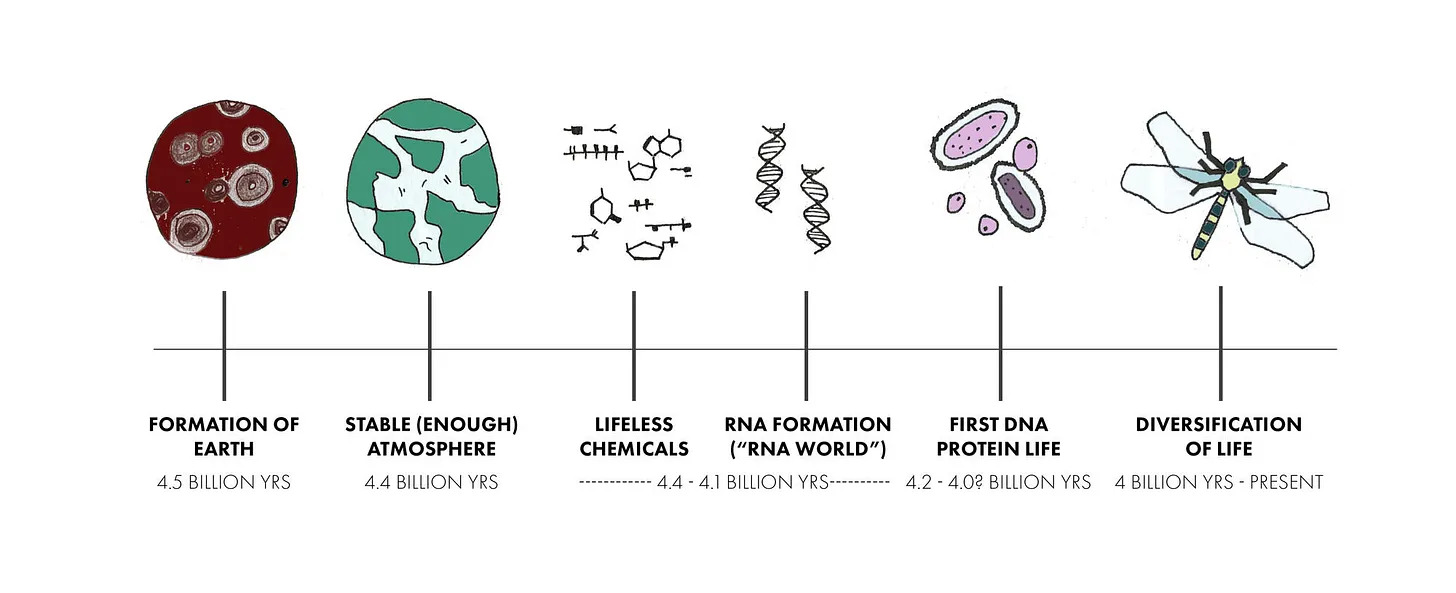
The entire question begging process of trying to discover the origin of life as presented by Szostak and team is a reductio ad absurdum: it has proven the exact opposite—that life can only arise from life. There is no reason whatsoever for life to have ever arisen based on scientific materialism: non-life only results in non-life, if a semblance of life arises it must have been pre-existing. The diagram on the timeline of the origins of life conveniently shows the ‘First DNA Protein Life’ popping up suddenly and for the most inexplicable of reasons, i.e. that no reason is needed, for this to happen: resulting in the ‘Diversification of Life’. These are untestable hypotheses, assumptions, and assertions which are quite unscientific. They can never be proven false, they always seem to imply being true. But the truth is these claims cannot even be proven to be true. Note the conclusion of the article: “…the team has tested only a fraction of the possible variant nucleotides available on early Earth. So, like those first bits of messy RNA, their work has only just begun.” This is after decades of failure to prove life can arise out of non-life whether in a lab or brought in through outer space.
The conclusion from the original paper itself: “Considerable additional experimental work must be done to extend this model, as only a fraction of the likely prebiotic variability in nucleotide and nucleic acid structure has been explored to date.” There are many issues here but a defining characteristic of OoL is to put forward theories that cannot be proven; it is said the findings may or could result in the living arising out of the non-living but more research is needed, even decades and millions in funding later. And if a ‘primordial soup’ cannot pass muster then perhaps it came from a galaxy far, far away…(perhaps is would be better described as ‘The Thing from Outer Space’): asteroids, meteors and other planets must have something that could have added an ingredient to the ‘primordial soup’ on Earth; but if the particle from a rock on the moon or elsewhere shows a bacterial form—where did that come from? The OoL response: ‘primordial soup’, a rock from another planet landing there etc.; all that resulted in a Frankenstein hodgepodge of cells (yet all the while assuming they have the attributes of something living). Remarkably, this is called science. The fallacious reasoning involved in the ‘primordial soup’ theory can also be expressed as a causal slippery slope form of argument/fallacy, i.e., that there are incremental causes between non-life and life that can be bridged over time when there is no warrant for that. This means there is simply no evidence at all that such a life-giving process is possible for the Frankenstein effect to take place in Szostak’s sanctioned version of heterogeneity underlying the ‘primordial soup’ theory. From the Frankenstein article (my italics): “If the more efficient early version of RNA reproduced faster than its hybrid counterparts, it would, over time, out-populate its competitors.” And it cites Szostak as saying: “‘The intrinsic chemistry of RNAcopying chemistry would result, over time, in the synthesis of increasingly homogeneous bits of RNA.’”
A look at the diagram indicating an approximate timeline of the origins of life on Earth shows that (my italics) ‘Lifeless Chemicals’ took 4.4 billion to about 4.2 billion years or so for the ‘First DNA Protein Life’, and from there up to 4 billion years for the start of the ‘Diversification of Life’ which somehow evolved through a random unguided process into all the life forms we have today, including human beings: over time. Given the immense amount of time that apparently this process is supposed to take, how is it that life can be produced in a lab?
- Would it not be obvious that this whole OoL endeavour only makes sense over tremendous periods of time?
- Would it, thus, not be obvious that it cannot be replicated in a lab in the insignificant amount of time used in experiments?
- Would it also not show that if it is most unclear and tentative that such a possibility actually did take place (life out of non-life) over massive amounts of time that the continuing scientific attempt to play Victor Frankenstein is unwarranted?
- Is it not clear that prebiotic Earth cannot be simulated in a lab?

Furthermore, a hidden assumption in the ‘primordial soup’ or ‘warm little pond’ theory is that it posits that one little ‘pond’ could cause life to evolve and spread all over the planet. Even if granted that there were many ‘warm ponds’ or ‘warm puddles’ their impact is lukewarm as best: for how many ‘ponds’ are needed for life to form in? Far more striking is this haphazard and unlikely possibility underwrites the postulate that life could consistently evolve and be generated this way, and that we see fully formed, whole beings and species populating the planet rather than a mix that leaves the most deformed looking creatures hobbling around (neither is there any significant evidence of this from past discoveries). It would make sense to claim one source for the creation and evolution of such a variety of living forms from the minutest to largest of beings; yet, we are told to believe all this is supposed to be possible from a ‘warm pond’ or to be charitable, a multiplicity of ‘warm puddles’: all struck or heated up by the right number of lightning bolts to shock life out of the non-living.
Importantly, the slippery slope argument OoL makes further implies the difference between the non-living and the living is merely a matter of degree for somehow that which is lifeless can vitalise itself into life; the question then is if that is so what exactly is the difference between life and non-life? This seems like life is but the living dead which then goes back to being dead and falls apart when that ‘spark of life’ is extinguished. So, the difference between being alive and dead is a matter of degree, or terminology. Either we are always alive and then come into being again in the form of matter, and are subject to birth and death, and rebirth (explained by spirituality)—or, that life is eternal (covered by all major spiritual teachings)—or we never existed or were always dead, strangely came into life mixed in matter, then go back to death and decomposition (and presumably non-existence forever): a most fascinating form of nihilism.
If scientific materialists then claim anything that has a semblance of spiritual or non-materialistic ideas violate the requisite basis for science—and so are invalidated from being considered ‘scientific’—then they must state unequivocally: that the purpose of science as taught, practised, and funded is the maintenance and promotion of materialism. This has nothing to do with truth. Being ‘scientific’ has nothing to do with truthfulness, does not promote truth, does not push boundaries beyond materialism, and truth is irrelevant to the pursuit of knowledge (quite the claim). Not only is this perverse but certainly does not qualify as progress.
Most importantly, we still cannot define and know what precisely life is though we can state characteristics of it. That the fallacies mentioned are endemic in OoL but are accepted as representing scientific endeavour is mind-boggling. The only evidence we have is that life arises from life, and as discussed in “Darwinism: game over” the best indicator of how such a process takes place is through Intelligent Design (ID).
The work of scientists and thinkers who see ID as a way forward include Biochemist Michael Behe, and philosopher of science and writer Stephen Meyer. However, ID is presented misleadingly by scientific materialists as bringing in God through a back door; ID does not posit a deity but a mind that is responsible for all the indications of design in the workings of the cell, and the universe. A mind implies life, and so life originally comes from some form of life. ID consistently provides a meaningful context for the ever complex, intricate, machine-like precision and order with which cells work. Moreover, ID is not only gaining traction but allows scientists to enhance their process of discovery beyond the meaningless, inaccurate, and straitjacketed framework of scientific materialism which is an ideology. Crucially, ID uses ‘Inference to the Best Explanation’ or abductive reasoning: what is the most likely conclusion we can draw from what is observed around us. Given that there is information encoded in DNA, and the regularity, purpose, and efficiency in the activity of cells: what in our world shows the closest proximity to how such things occur? It is the way we do things, communicate, the patterns and design in what we create; much of DNA and cells function similar to computer programmes: so we can infer that the order in which these entities work is the result of design—not random, unguided, fortuitous processes. Like a computer programmme, cells show a certain consistency and regularity in how they behave, and they are highly ordered in functions. And inferring the other way around: like cells, computers can be infected by viruses not because the computer is alive but as an analogy to how actual viruses operate; they subvert the functioning of the host: abductive reasoning at work. The reasoning works because the analogue of design between the two fits well.
Clearly, ID discards the ‘primordial soup’ model or life springing out of the inanimate and is critical of OoL. But perhaps the most vocal proponent of the misleading nature of OoL is synthetic organic chemist and nanotechnologist James Tour. The analogy he and Meyer provide on informational code or informational response to code is again that information and code underpin communication and how computers work. Language is information and a code, and it is the medium for passing instructions and knowledge. But a mind must interpret and act on it. Thus, a mind should be responsible for the encoding and a mental process must be in play for the interpretation of code and information that allows for living entities to function utilising the code.
Notwithstanding, Tour is not a supporter of ID though he is sympathetic towards it as evinced in Beyond Evolution: Unraveling the Origins of Life (my italics):
[T]he DNA is a piece of this informational code. But everything in the cell is informational code. The saccharides, the way sugars are put together bears information. That’s how cells tell one another apart. I mean, they bump into these other cells, they see what the saccharides are…All the amino acids, all the proteins, those all have information so that they know what molecule to build. Every piece of the cell is information…How does this information get translated if you don’t have fidelity in information transferred? We tried this years ago in my lab to try to make a starting molecule and have it [in turn] make a duplex, a daughter molecule, just like itself not using biological entities [replication]. And what happened was the fidelity killed us, meaning that it was only 70% pure so you have 30% still in there now, reproducing junk. And before you know it…it’s just a mess.
Tour also gives a response to the recurring and spurious claim that given enough time or ‘over time’ as Szostak et al. espouse, materialism spontaneously generates life. In Dr. James Tour Destroys Origin of Life Myths with Hard Science we learn:
[T]ime of the gaps: if we had enough time…that’s what the argument is…if we had enough time these things would come together…that’s a time of the gaps argument but these people who work in the area…see exactly what I see, so they don’t send me emails criticizing me, they’ll never pick out and say well ‘Tour said this, that’s wrong’. I did a nine-part series, it’s 10 hours maybe 14 hours, of teachings on this; you would think that if I got something wrong, they would jump all over it [but] nothing.
[They claim in] their findings that we’ve solved most of the paradoxes in Origin of Life [research], that we’re able to make the RNA, and once the RNA could form then we could make proteins and the enzymes would then do the assembly: none of this is true.
The ‘time of the gaps’ is Tour’s riposte to scientific materialists’ claim that if there are any unexplainable phenomena it is the tendency of some theists to bring in God (i.e. ‘God of the gaps’) as an excuse to justify ‘mystery’ in phenomena when there is no proper answer why something happens, to fill a gap in our understanding. However, scientists who are inclined towards theism do not accept that as what cannot be answered requires further inquiry, and much of scientific discovery is the result of belief in God as the guarantor of being able to understand the universe and life (e.g. Galileo, Kepler, Newton). The ‘time of the gaps’, thus, refers to the belief by OoL adherents that given enough time life could emerge from non-life despite evidence to the contrary: that the mystery or inexplicable aspects of life and existence are explained away by ‘time solves everything’; given enough time, the universe can be created, untold number of galaxies form, life spring into being, etc.—just fill in the gaps (blanks) for your wish list, time miraculously makes it all possible.
Tour then delivers a coup de grâce on OoL’s creation myth that life can be created in a lab:
They can’t make life, nobody’s ever made life, but even if they could it doesn’t explain how it happened on an early Earth; they’re what’s called prebiotically relevant experiments, you would have to show that each one of those things that you did in your lab with modern experimentation could have been done when there were no instruments around, with these large chemicals.
And as he says elsewhere:
Those who think scientists understand how prebiotic chemical mechanisms produce the first life are wholly misinformed. Nobody understands how this happened. It would be far more helpful to expose students to the massive gaps in our understanding…
[And to those who say he is bringing God or ID as an explanation he responds as follows:] I don’t know how you can take what…I was suggesting, as God, why can’t we just have a wholly new scientific theory…[which] I don’t know yet.
Tour, who is a theist, insists that his scientific attitude keeps him open to a scientific explanation to the origins of life that may not have to necessarily bring in ID but it would certainly be an option; he provides far more openness and reasonableness in trying to give a professional and serious assessment to OoL issues than its avowed practitioners: who shut everything out beyond scientific materialism which regards ID as anathema. In a tour de force (pun unintended) statement Tour says (my italics):
I wish you could see what I see, even if you just take a cell, very simple cell, and you ask scientists to look at this cell, life is going on. If you just put molecules, align them in that way, is it going to run, is it going to operate? We don’t even know what got this cell going, we don’t know.
So, if you ask a scientist, a cell just died, what is it we just lost, all the molecules are right there, and could you get it going again? We don’t even know how to describe what life really is when it comes to even a simple cell, we don’t even know that, that’s how clueless we are. I wish you could see this, because you don’t understand the magnitude of the human deficiency in even understanding what life is in the simplest of organisms.
And people will say, well, life was much simpler at the start of the evolutionary process. This has already been calculated; bioengineers have already figured out what is the minimal operation that you need. What are the fewest components that you need to have a cell operating. And you take that and, okay, so let’s say we make all of those components.
[But] none of those 15 components have been made, none of them. Now, if you could make them, now what would you do? Even if you could make them in your current lab. I’ll give them their own labs, make them, or just take them from a living cell, go to a living cell, use that as your supply chain, take it from the living cell. Now what do you do?
Just putting them in proximity, is this going to run? Nobody in their right mind would say ‘Yes’…it’s not just putting them together. You don’t know how to put them together, but even if you could, now how does it even start running?
We don’t even know what we’re going toward…what are we going toward in life? We don’t even know what life is, molecules don’t care about life…they don’t move toward life. There’s no propensity for a molecule to move toward life, it has no brain, it has no action that wants to bring it toward life, they don’t know: I don’t know what you want me to do, I’m just here, what do I do? And then even if we could say I want you to move toward life, you’d [molecule] be like, okay, just tell me which direction to go, I [molecule] don’t know.
His words are clear enough. Tour is saying what many of us know but some scientists are unwilling to admit: there we still do not even know what precisely is life, and the waste of time and resources on OoL have only revealed that continuing down its current path is an excuse for an infinite regress of looking for life all over the cosmos, but never being able to explain how it began, or ever admitting that only life begets life; that there is an order and design to life that is difficult to deny. It is not that there should never have been OoL but the verdict is in: the scientific data shows molecules do not care about life. Life has yet to be defined and understood properly. There is no reason for life to exist or form, no reason for the universe to exist, no reason for us to be here: yet, here we are. Why? To say it is due to happenstance and random, unguided processes is completely unacceptable and irrational in every way. Scientific materialism is willing to give God-like powers to matter (and time) so that it can explode out of nothingness, conjure life from the inanimate; that the myth the non-living can suddenly arise and live is acceptable. Scientific materialists believe that the inanimate can undergo a resurrection; but any belief that a spiritual being may have died and may have been resurrected does not conform with materialism and is, therefore, unacceptable: as that can only be the fancy of spiritualists—miracles happen only when scientific materialists say they happen.
One of the lessons from Frankenstein is the danger of hubris and ignorance by those who claim to be highly skilled and knowledgeable. The Creature Victor brings forth becomes his nemesis. Victor’s downfall is caused by his defiance of Divine Order in order to prove nihilism; that all is nothing, but that nothing can yield life if prodded appropriately, and after life has been agitated into existence it disappears into death and nothingness again: it is all meaningless and empty, and we ascribe what we want to it. Scientific materialists’ ambition is congruent to Victor’s; and it is necessary that all comes from nothing otherwise it is no achievement to force life out of a Petri dish in a lab. The corollary of all this is that Life is nothing, we are nothing, for we come from nothing: this is the credo of scientific materialism which is not willing to admit even this.
Mary Shelley was well aware of the science of her day as her novel showcases; apart from galvanism she was aware of the works of prominent chemist and inventor Sir Humphry Davy (1778-1829). Of course, she was also examining the philosophical and spiritual implications of the attempt by some to overreach through science and materialism (her husband Percy Shelly, in his youth, was an example). As scholar Anne K. Mellor states:
Mary Shelley based Victor Frankenstein’s attempt to create a new species from dead organic matter through the use of chemistry and electricity on the most advanced scientific research of the early nineteenth century. But Frankenstein reflects much more than merely an intelligent use of the latest scientific knowledge.
Shelley was surely aware of Davy’s “Historical View of the Progress of Chemistry” from Elements of Chemical Philosophy (1812) in which he makes clear (my italics):
The object of Chemical Philosophy is to ascertain the causes of all phenomena of this kind, and to discover the laws by which they are governed. The ends of this branch of knowledge are the application of natural substances to new uses…and the demonstration of the order, harmony, and intelligent design of the system of the earth….
The more the phenomena of the universe are studied, the more distinct their connection appears, the more simple their causes, the more magnificent their design, and the more wonderful the wisdom and power of their Author.
Davy, and by inference Shelley, were aware of the idea of ID before it was officially taken up as a scientific heuristic in our time. And they were unashamedly theistic because that does not diminish scientific endeavour nor human curiosity: which is contrariwise to dogma that claims there are only materialistic answers to science. It is, therefore, unsurprising that the epigraph describes the transgressive act of the student’s to recreate life from the inanimate as “supremely frightful would be the effect of any human endeavour to mock the stupendous mechanism of the Creator of the world”. The “stupendous mechanism” being a reference to the Intelligent Design of the universe and all life, just as the workings of a living cell are a “stupendous mechanism”. As Davy enunciates: there is indeed a Divine teleology at work that is unmistakable to those who observe seriously and sincerely the workings of the cosmos and life.
Only ID makes sense when it is said life developed or started over time; it is plausible that the process unfolded with a Universal Mind/Consciousness initiating and designing the cosmos and life. How exactly all that works we do not know, yet; though we have gained glimpses of it via genuine scientific discovery. The insistence by scientific materialism that life arose from the inanimate because with enough time such staggering events could happen is unconvincing. No matter how uncomfortable it is for some that ID implies a designer, the evidence revealed from the observation and examination of the world and life forms supports the notion. And it is our basic intelligence and common sense that should make us ask as does writer, mathematician and thinker David Berlinski, when he mentions what a renowned cosmologist said some years ago when he queried other cosmologists (my italics):
[T]ell me you got the electron…it’s going around here…and it follows an orbit and that orbit determines the chemistry of ordinary life, and that electron does the same thing all the time. What compels the electron to stay in its orbit? Notice the choice of words: what compels the electron to stay in its orbit, notice the resonance what compels us not to press the button [that could kill someone we do not know, a thought experiment]; notice the questions are the same. What is the source of binding compulsion whether in the moral life or in physical life; notice at once this transgresses the boundaries of Galileo’s Universe. This is not uniquely a question about the book of God’s work [the universe] because we’re talking about a moral issue. This is not uniquely a question about the physical world for the same reason, and yet when we look at the logical form of the question what compels the electron again and again…there is some compulsive Force at work that we all recognize but cannot name.
Even broken in spirit as he is, no one can feel more deeply than he does the beauties of nature. The starry sky, the sea, and every sight afforded by these wonderful regions, seems still to have the power of elevating his soul from earth. Such a man has a double existence: he may suffer misery, and be overwhelmed by disappointments; yet, when he has retired into himself, he will be like a celestial spirit that has a halo around him, within whose circle no grief or folly ventures.
Mary Shelley, Frankenstein (the words and effect of “the starry sky” are reminiscent of lines from Immanuel Kant, below, who predated Shelley).
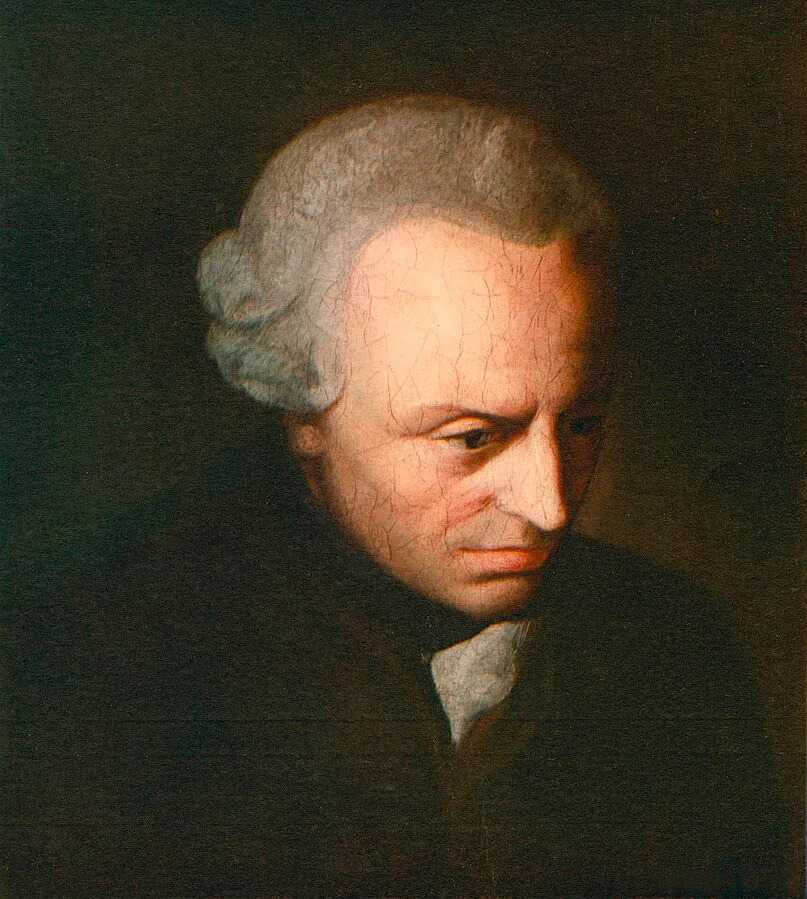
Berlinski asks an important question, why are elementary particles working the way they do? Why must an electron continue spinning, why do they even have to exist? Why could not all matter just collapse and not function and all life simply disintegrate? What compels a molecule to move towards life or to even work? What compels the interpretation of informational code that propels cells and all life in response? What compels us to make a moral choice or be aware of right and wrong, and ponder moral issues? Why are there laws of nature that coincidentally parallel moral laws in that the term ‘law’ is used to show a regularity and order to certain events or decisions; moral decisions are also made rationally after considering various options. There is a system of order and regularity, that makes sense if purpose is given to all that exists and continues to exist for the time span allotted. The great German philosopher Immanuel Kant (1724-1804) in his work implied that the rational mind understands the world due to the intelligibility of the world. If we could not understand the world we live in at all via reason there would be no science, nothing to discuss, no sense to even trying to make sense about anything, just chaos. Similarly, through reason the moral law is discernible when a person is compelled to do what is right for the highest good of all, usually after due consideration; and that would usually be an act that goes against what may sometimes be seen as our own self-interests: an instance would be speaking truth to power, or standing by someone who has done the right thing but is attacked by the majority. Perhaps an obvious example would be helping someone in danger despite the risk to ourselves.
For Kant, such instances could qualify as acts of rationality. It is reason that tells us that much of what is propagated as OoL is false, misleading, a massive waste of time, finances, and resources. Clear thinking and integrity will take many out of their comfort zones to follow what the science actually shows: that there is indeed an order and design not only to the world but how we decide on moral choices. To Kant, there is a moral centre to the universe—it is not random, unguided, irrational nor nihilistic. There is a rational purpose to all we see and that the highest form of expression of rationality is not the fantastical notion of slime crawling out of a primordial pond that then develops incredible evolutionary powers that defy all understanding, nor conjuration of Frankenstein’s Creature which appears more like the result of unhallowed arts. We seem to be guided to the rational conclusion that the purpose of existence is humanity itself: for the human mind is capable of engaging a continuous process of discovery that reveals an increasingly wondrous design to all that exists: that we are here may be a reason the Earth is an extraordinary planet.
Two things fill the mind with ever new and increasing admiration and awe, the more often and steadily we reflect upon them: the starry heavens above me and the moral law within me. I do not seek or conjecture either of them as if they were veiled obscurities or extravagances beyond the horizon of my vision; I see them before me and connect them immediately with the consciousness of my existence.
Immanuel Kant, Critique of Practical Reason, 1788.
End notes:
[1] An author, scientist and biomedical engineer pointed out to me quite recently his concern that the law of biogenesis (life arising out of living organisms) has been somehow disregarded, even though it has never been contradicted; and in its place, schools teach the unvalidated theory of abiogenesis (spontaneous generation of life from inanimate or inorganic matter). He is indeed correct to be concerned. This only ensures that minds are imbued with a one-track approach to science, that it is an entirely materialistic reductionist exercise that keeps minds locked in dogma, rather than a genuine enterprise that explores possibilities in the search for knowledge and truth.
[2] This piece was written initially without the intention of focusing on Mary Shelley’s novel as a way to bring in OoL, though the option was considered. However, in the course of research “Life’s Frankenstein beginnings” suddenly emerged (abiogenetically as such), but I thought it was mere coincidence. However, it did not take long to realise the synchronicity with which the article appeared, just as it seemed Shelley may not be the right entry point. That still did not persuade me to start with Shelley. It was only soon after that the recollection struck: I had indeed been thinking of Shelley’s book even much earlier when it was first decided to write something on OoL; that convinced me it was not simply coincidence and so I began with her.
The writer is the founding editor of Philosophers for Change.
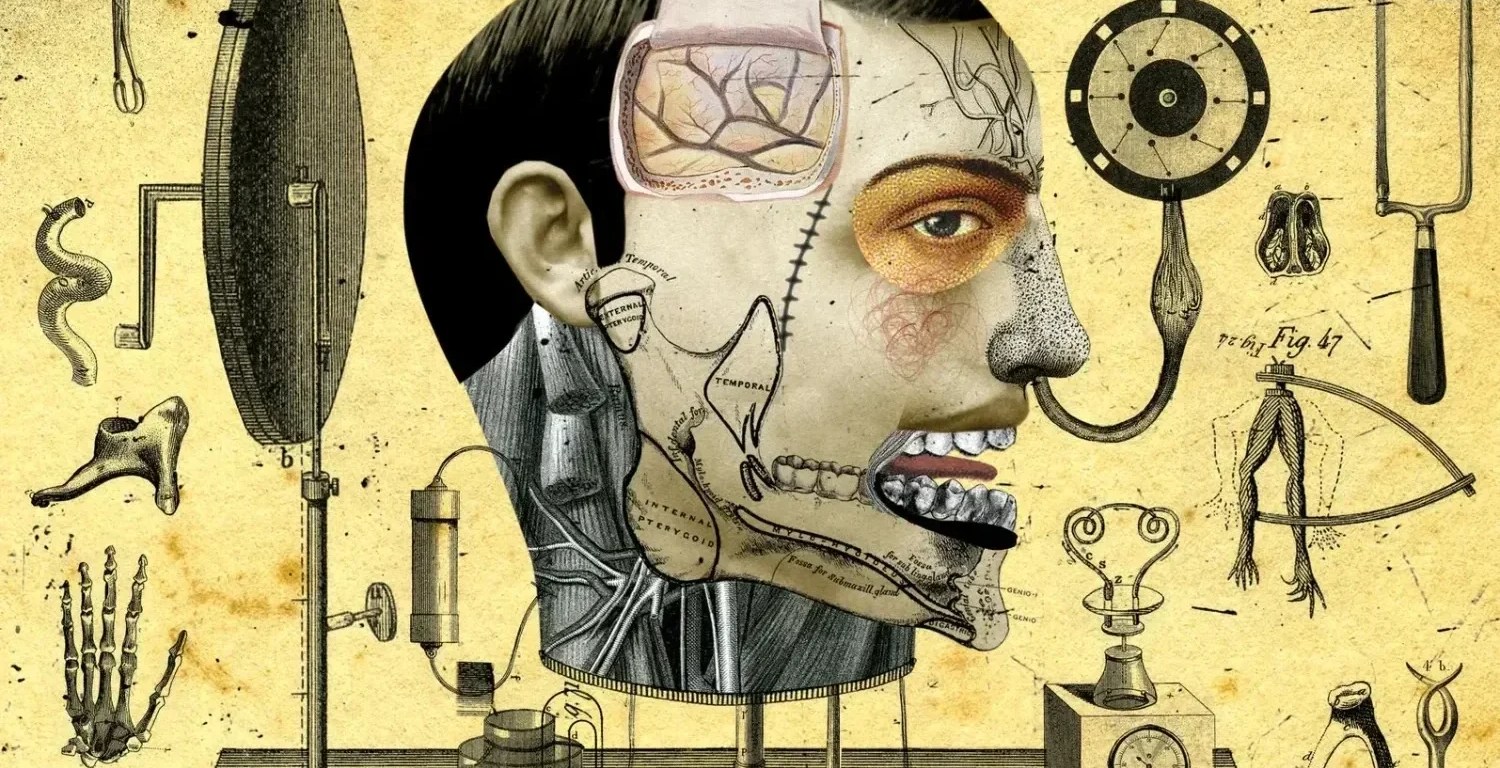
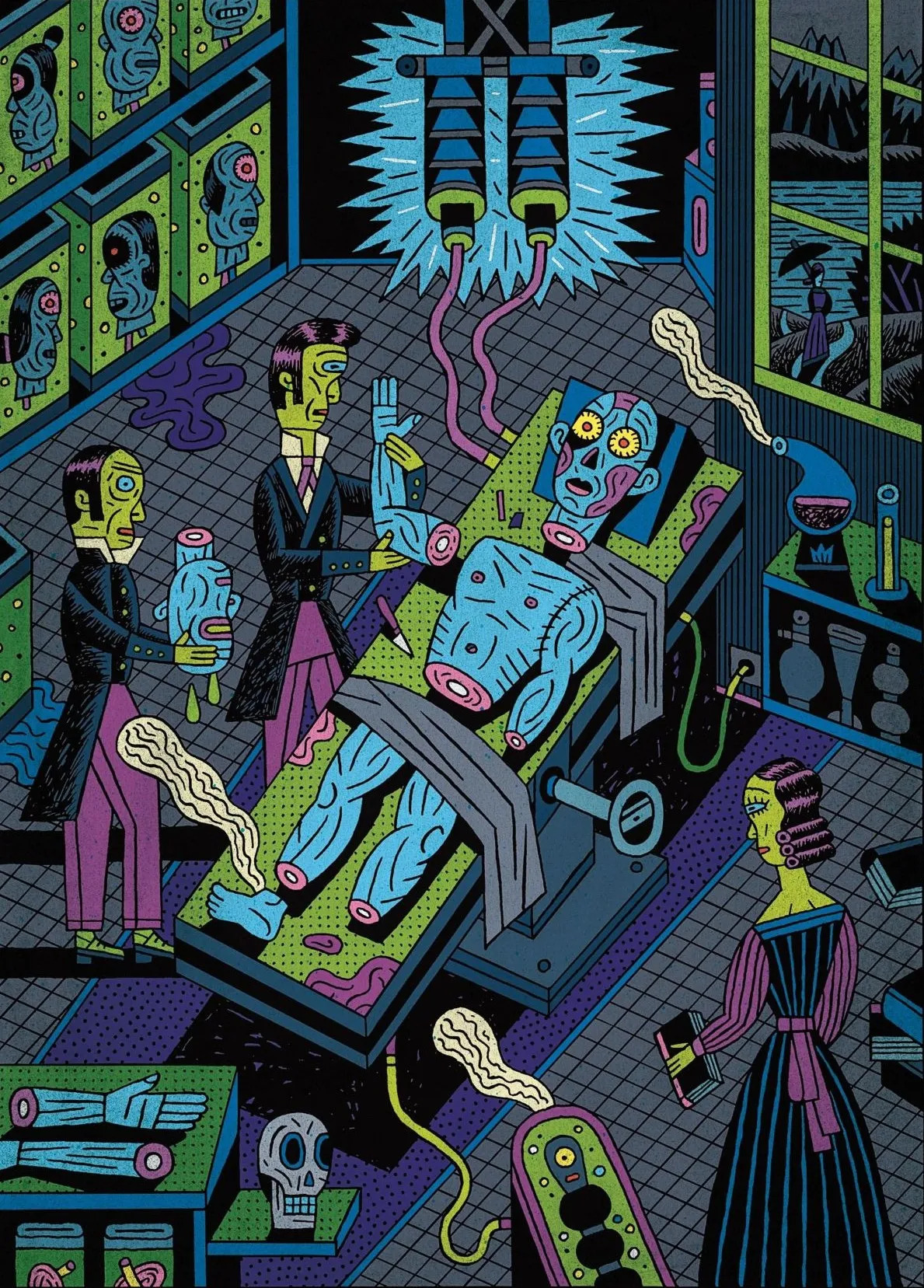
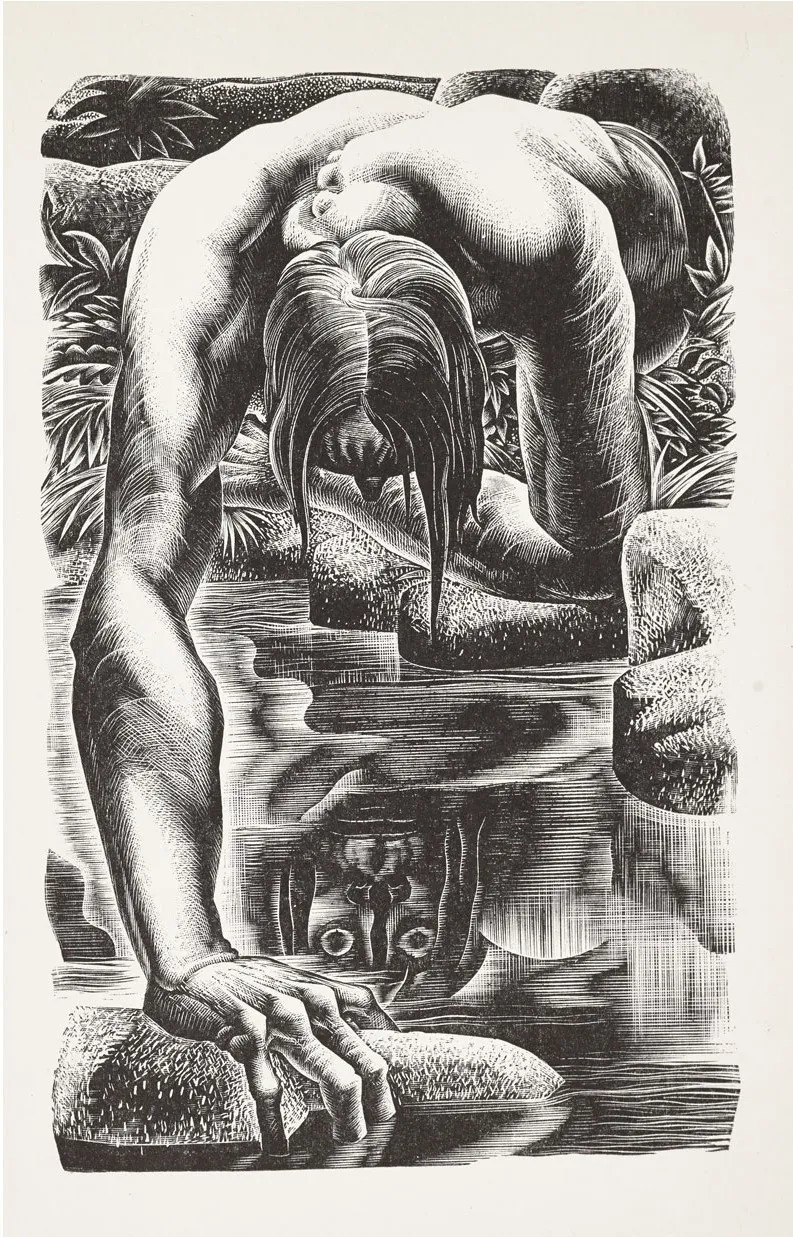
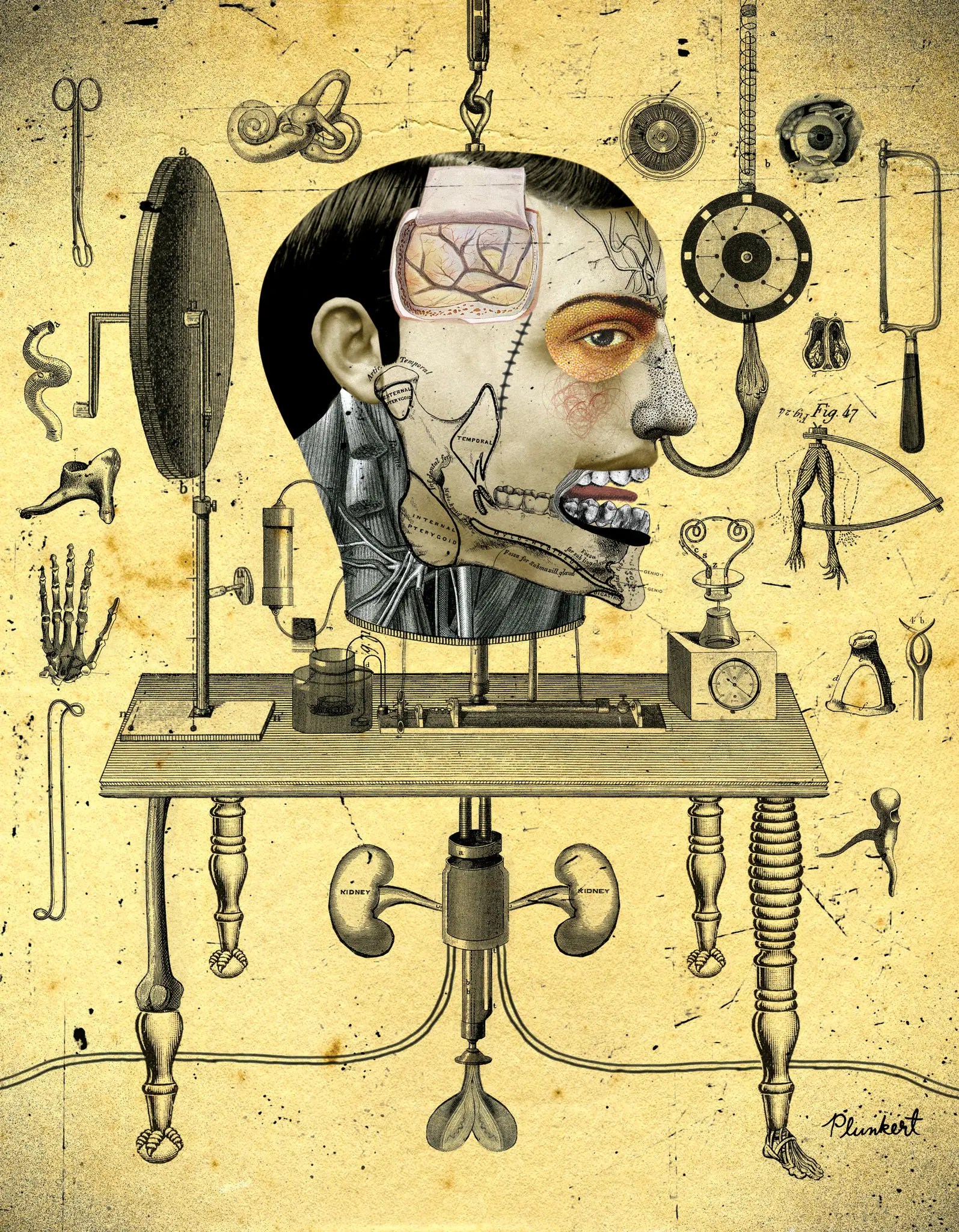
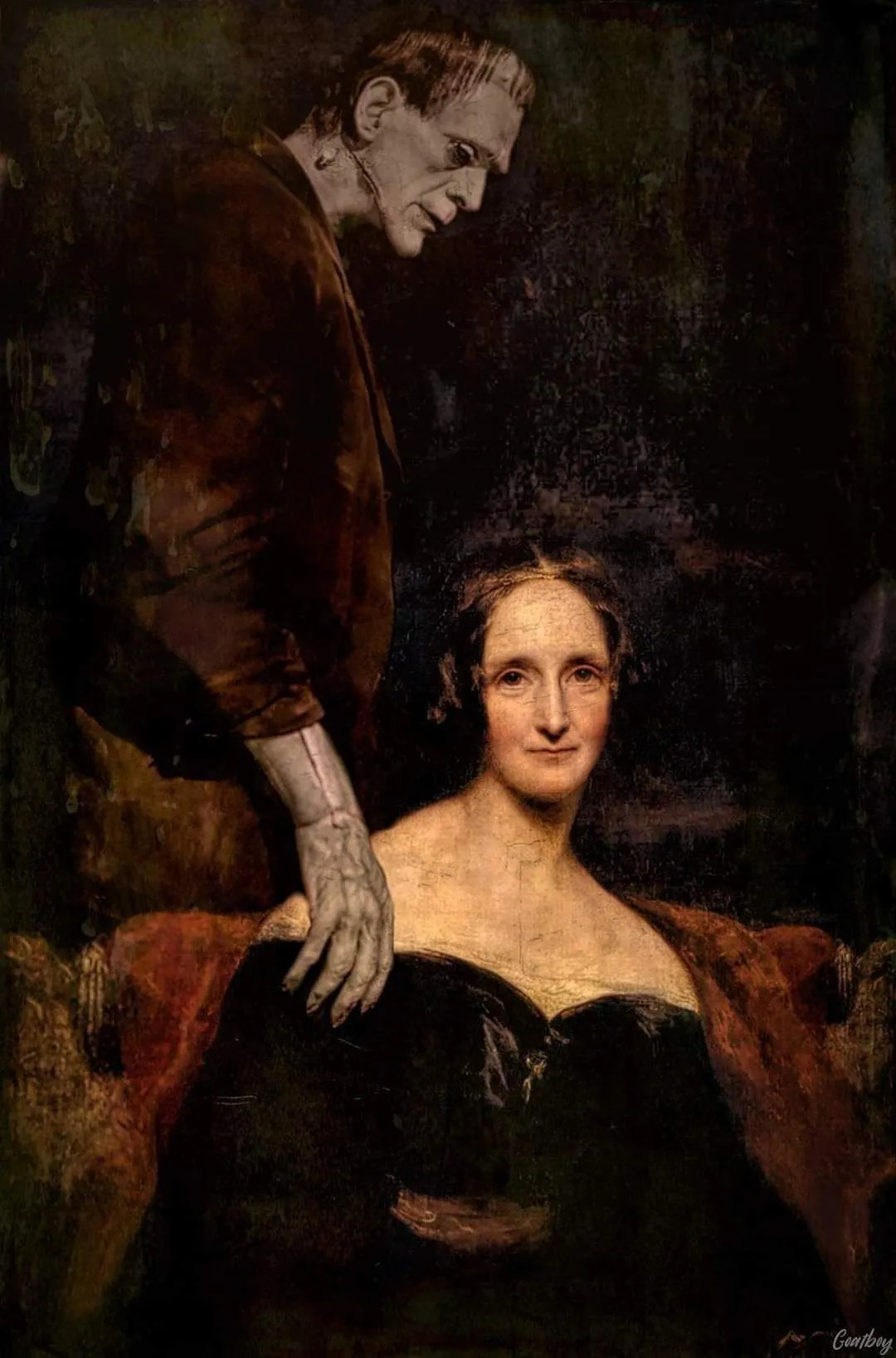
[Featured picture credit: David Plunkert. Top picture credit: HenningWagenbreth. The lady in the background and foreground represents Mary Shelley.]
If publishing or re-posting this article kindly use the entire piece, credit the writer and this website: Philosophers for Change, philosophersforchange.org. Thanks for your support.
This work is licensed under a Creative Commons Attribution-NonCommercial-NoDerivs 4.0 International.

 Philosophers for Change