

The demonstration must be against learning—science. But not every science will do. The attack must have all the shocking senselessness of gratuitous blasphemy.—Joseph Conrad, The Secret Agent.
by Sanjay Perera
A RECENT film that may have accidentally captured the zeitgeist in many parts of the world is Brady Corbet’s remarkable The Brutalist. An epic film that is difficult to watch in many ways: it deals uncompromisingly with the challenges and persecution a talented Hungarian Jewish architect and his wife endure in trying to fit into America after surviving the concentration camps of Nazi Germany. However, it is the sexual assault later in the film and the explicitness of some scenes that weaken inadvertently an otherwise outstanding film. Corbet has created a near masterpiece but could have benefitted from stating his case without having to engage with so many other films and works of fiction in numerous ways; sometimes this works (as in Coppola’s Megalopolis—which also deals with creativity, designing and building) but sometimes attention drawn to the references somewhat distract from a narrative that is already effective in itself. It is an unusual work that would have been more effective as a novel than a film, for the printed word would have translated the ideas of the film powerfully and with greater restraint: the problem with visual representation of explicitness is that it controls the viewer’s vision in a way that occludes the imagination which readers of a book are granted (which is as much as a reader requires to inform their interpretation of the narrative without it being framed overtly for them).
Notwithstanding, the film is complex, moving, and visionary on many levels: but the film has close dialogue with Sergio Leone’s (1929-1989) underrated masterwork of cinema, Once Upon a Time in America (the full version)[1]. The movie revolves around the lives and fates of a group of Jewish American friends who take part in gangsterism. Th explicit violence in that film, and the brutal sexual assaults portrayed surpass that of Corbet; but Leone operates at a level of pure cinema that is hard to compare with today (Alfred Hitchcock being another); it is said he envisioned the entire film in his mind, and shot it accordingly (with a script, of course). The film would not have worked as a novel as such (think of any of Leone’s great films as a written text: it is obvious they work solely as a visual and auditory medium). The movie also explores the desecration of the beautiful by brute force, the violence underpinning artistic achievement, and the artist at times clinging onto the source of abuse which paradoxically supports his work. An overall theme in the film is that of illusion, addiction—literally and metaphorically—art as the opium of the artist, and so a means to blunt suffering; the distortion of memory to suit our purposes which can also drive artistic expression: ideas paralleled in The Brutalist.
It denotes a difference in time. The monument’s registration of this difference makes for a place of loss and contemplation, elements of memory…The time of the monument, its duration from top surface to ground, is disjoined from the time of experience. In this context, there is no nostalgia, no memory of the past, only the living memory of the individual experience.
Text for Eisenman’s Holocaust Memorial (2005).[2]

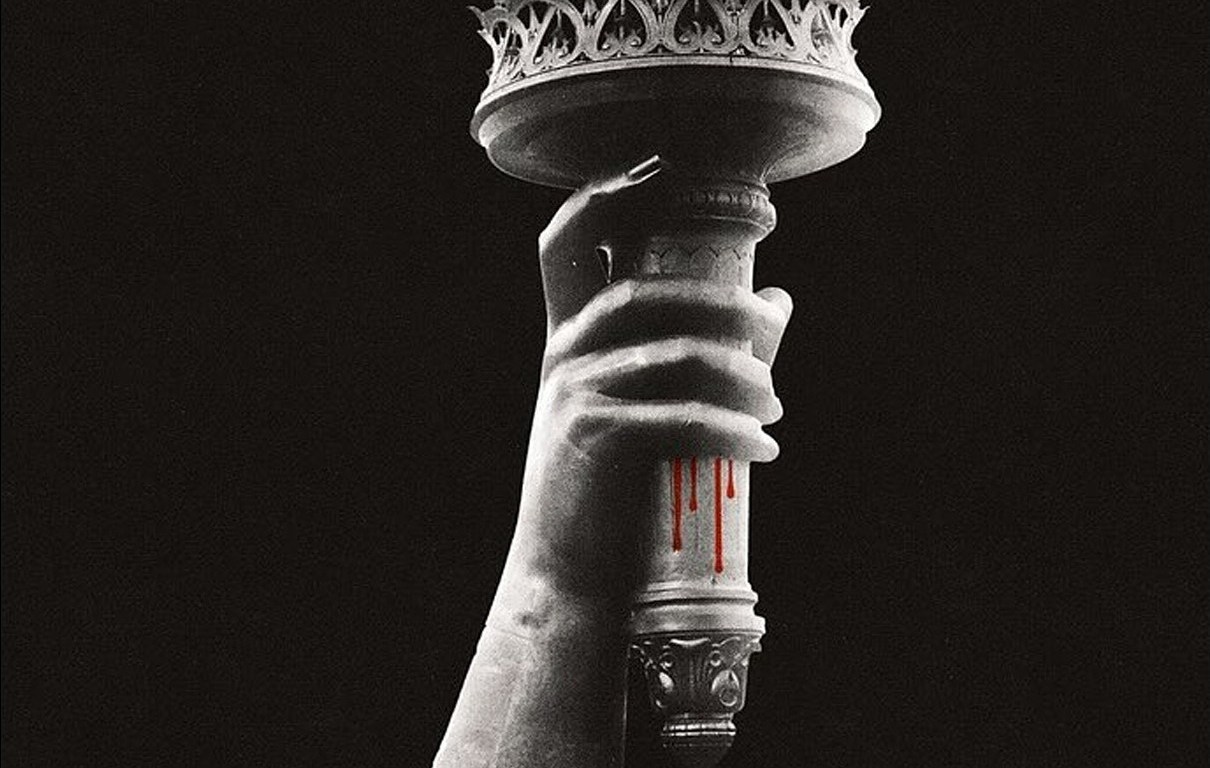
However, the brutalism of Corbet’s film also refers to architectural brutalism which is a 1950’s style of architecture that in turn reflects the French concept of béton brut (“raw concrete”) and art brut (“raw art”): indeed, the film epitomises these in its themes and the brutality in the lives of its characters—though at its core is a love story redeemed by architectural art and beauty that simultaneously reflects the pain of its protagonists, and the agony of the Holocaust as historical and living memory. But the film does examine the need for art and genuine artists to stand up against the pressures of those who choose to control the world and the lives of others through force, power and violence. The memorable early scene in the film is the sight of the inverted Statue of Liberty that greets László Tóth: a symbol of the subversion of all the statue and American ideals signify. If anything, László and his wife face trauma of a different kind than that under the Nazis, but it is still harrowing and the violation of their humanity is all the more humiliating when they are supposed to be in the ‘Land of the Free’.
In a world of increasing dysfunctionality like ours we are regularly confronted by those who use the pretext of championing a cause to highlight the plight of those in war-ravaged communities: to intimidate and attack others; these ‘activists’ suffer from a form of arrested development for which the rest of us must also pay a price. Theirs is an attempt to push an agenda, and distract from actual justice and fairness: through violent protest, demonstrations, riots, and even subversion of the will of the people as in going against democratic choice.

‘Everything that is ugly, cruel, stupid—but, most importantly, ugly—everything: is your fault.’
László Tóth says this to a commercial architect who tries to add mundanity to his unique vision; The Brutalist.
The recent pro-Palestinian protests at Columbia University and the attempted takeover of the Butler Library by 100 masked hooligans is a low point for free speech in America. Truth be told, it has nothing to do with freedom of speech but brazen disruption of the safety and right of students to study. The self-styled activists declared the library a ‘Liberated Zone’ resembling the unnecessary disturbance of campus life and students’ legitimate activities of last year’s “Gaza Solidarity Encampment” at Columbia. These people are role-playing ‘freedom fighters’ on a US campus rather than venturing to take on their actual enemy, Israel, in the Middle East itself: an exemplary demonstration of cowardice. They choose to persecute fellow students instead, create chaos for those who are trying to have an education and working hard to prepare for their exams—at an institution with inordinately expensive tuition fees. Such activities, to the dysfunctional, are seemingly the best way to win friends and influence people: and how would such blatant narcissism and sociopathic behaviour engender pro-Palestinian sympathy, or empathy with the protesters?
This disorderly conduct resulted in the New York Police Department (NYPD) responding to Columbia’s request to bring law and order to the campus with the arrest of about 80 protesters. Additionally, two of the campus public safety officers ended up injured during the fracas. The protesters, some of whom are said to have been expelled previously for antisemitic activity on campus, are mainly from CUAD (Columbia University Apartheid Divest): a so-called coalition of organizations for a free Palestine.

Columbia’s new president made some statements concerning the protests in the wake of the US government finally cutting off US$400 million in grants and contracts due to the university’s poor record in countering harassment of Jewish students. According to Acting President Claire Shipman:
Earlier today, a group of protesters occupied one of the main reading rooms in Butler library, refusing to leave, and another group breached the front door causing substantial chaos—all of this as the bulk of our students are working hard to prepare for exams. These actions not only represented a violation of University policies, but they also posed a serious risk to our students and campus safety. We had no choice but to ask for the assistance of the NYPD, and I’m grateful for their help and professionalism, as well as that of our Public Safety team. Let me be clear, what happened today, what I witnessed, was utterly unacceptable.
I spent the late afternoon and evening at Butler Library, as events were unfolding, to understand the situation on the ground and to be able to make the best decisions possible. I arrived to see one of our Public Safety officers wheeled out on a gurney and another getting bandaged. As I left hours later, I walked through the reading room, one of the many jewels of Butler Library, and I saw it defaced and damaged in disturbing ways and with disturbing slogans. Violence and vandalism, hijacking a library—none of that has any place on our campus. These aren’t Columbia’s values.
Let me be clear: Columbia unequivocally rejects antisemitism and all other forms of harassment and discrimination. And we certainly reject a group of students—and we don’t yet know whether there were outsiders involved—closing down a library in the middle of the week before finals and forcing 900 students out of their study spaces, many leaving belongings behind. Our commitment to a safe, inclusive, and respectful campus community is unshakeable, and we will continue to act decisively to uphold these values…
I am particularly heartbroken, and incensed, that this disruption occurred when our students are intensely focused on critical academic work. At a moment when our community deserves calm and the opportunity to study, reflect, and complete the academic year successfully, these actions created unnecessary stress and danger. I have seen how much our community wants to take back our narrative, to do what they came to Columbia to do—learn, thrive, and grow—not take over a library…We, at Columbia, value freedom of speech, robust debate, and peaceful protest. Today’s disruption of Butler Library was not that. We must, and we will, come together as a community to consider what civil disobedience actually is and what it means. We need to recognize that when rules are violated, when a community is disrupted for the sake of a few, that is a considered choice—one with real consequences. There is a clear line between legitimate protest and actions that endanger others and disrupt the fundamental work of the University. Today that line was crossed, and I have confidence the disciplinary proceedings will reflect the severity of the actions…
Let me also say this. I’ve received many messages from concerned parents. The group involved less than one percent of our 36,000-person student body. Their actions had a disproportionate impact…
So, we will get back to business. Our real business. The business of teaching, learning, studying, and researching. We have an incredible Commencement to look forward to and finals to prepare for. We will move forward together to show the world the best of Columbia.
(However, at the recent commencement ceremony Shipman bizarrely and hypocritically mourned “the absence of our graduate, Mahmoud Khalil” and riled further students already divided over Columbia’s protest shenaningans: and was even booed. The notorious Khalil, a spokesman for CUAD and other anti-Israel groups, was arrested much earlier by ICE—US Immigration and Customs Enforcement—agents and awaits deportation; he is said to have been engaged in pro-Hamas activities.)

In contrast, there was a peaceful ‘protest’ to save hundreds of books against the rash bureaucratic decision to indiscriminately discard them at the closing down of Yale-NUS (National University of Singapore) liberal arts college in Singapore. Students and alumni were upset that books were treated this way. Some comments included:
‘It boils down to how much they care about the books and the taxpayers’ money they’ve used and are now throwing away.’—Ms Avery Huang, 23.
‘I felt heartbroken, seeing an unbelievable number of expensive books—many in near-perfect condition—being so carelessly discarded. It was painful to watch them thrown around like that.
‘Books are precious educational resources for communities to enjoy. In the right hands, they could have been thoughtfully cared for.’—Ms Lee Jiaying, 21.[3]
When institutions destroy knowledge so casually, they signal a disturbing disregard for memory, inquiry and the future of learning itself.
Ms Kristina Gweneth Simundo, 23, recent Yale-NUS graduate.[3]
However, it must be stated that Singapore does have its problems with self-radicalised youth, and the matter is taken seriously:
Today, there is an increasing number of terrorist attacks being carried out by self-radicalised individuals and lone wolf actors on everyday venues, using readily available objects such as knives and vehicles. The radicalised individuals are also significantly younger, have no prior terror links, and are influenced by extremist propaganda on social media.
Groups such as The Islamic State in Iraq and Syria (ISIS) have used social media to spread their ideology. The proliferation of extremist content online means easy access to such material, especially in a country as digitally connected as Singapore. The result is that some individuals in Singapore have become self-radicalised after being exposed to such content.
Self-radicalisation takes place when individuals consume such propaganda and start to believe in the ideology behind them. They then start to act on the ideology, which often calls for violent and physical attacks against specific institutions, people or groups. These can include innocent citizens, groups of a particular religious faith or even the government. Through the years, a small number of Singaporeans influenced by ISIS teachings have even travelled to Syria to participate in the armed conflict there.
Self-radicalisation presents an increasing challenge to the authorities, especially in identifying radicals who plot in secret and dealing with those who are radicalised within a short span of time.

Meanwhile, the upshot of the dangerous theatrics at Columbia as reported by the Columbia Daily Spectator:
Columbia placed over 65 students on interim suspension and barred 33 individuals from campus for their alleged participation in a Wednesday pro-Palestinian demonstration at Butler Library, a University official confirmed to Spectator on Friday.
Columbia alumni and individuals from affiliated institutions, which include Barnard, Teachers College, and Union Theological Seminary, are among the 33 individuals barred from campus.

As the drama unfolded at Columbia, a similar disturbance broke out at the University of Washington (UW) where over 30 pro-Palestinian masked agitators were arrested. They had occupied the engineering building at the campus and caused extensive damages that have amounted to at least US$1 million. Equipment and new facilities were damaged, classes were cancelled, and a fresh Boeing (which donated US$10million to the school) mural was defaced. The group, called Super UW, have praised Hamas’ Oct. 7 terrorist attack that resulted in the deaths of over a 1,200 people and 251 others kidnapped. According to their manifesto:
We are taking this building amidst the current and renewed wave of the student Intifada, following the uprising of student action for Palestine after the heroic victory of Al-Aqsa Flood on October 7th, which shattered the illusion of Zionist-imperialist domination and brought Palestine to the forefront for all justice-loving people of the world.
What does this even mean? And for those who decipher the gibberish what does this have to do with receiving an education? This violence addled verbiage is a meaningful as CUAD’s statements (the capital letters are from the original): “END COLUMBIA’S OCCUPATION OF HARLEM; RETURN LAND TO HARLEMITES AND OPEN THE GATES!”
In that same post, CUAD which is virulently antisemitic and purports resistance to Zionism states:
Today, the people refuse the name ‘Butler Library,’ which honors Nicholas Murray Butler, a shameless Nazi sympathizer and president of Columbia University from 1902 to 1945. During his presidency, Butler welcomed Nazi ambassadors to campus with open arms, limited the number of Jewish people who could attend Columbia, and expelled students who protested against Columbia’s ties with the Nazis.

It is apparently true that:
In 1919, Butler amended the admissions process to Columbia in order to limit the number of Jewish students (it became the first American institution of higher learning to establish an anti-Jewish quota). Butler’s policy was successful and the number of students hailing from New York City dropped from 54% to 23% stemming ‘the invasion of the Jewish student’. This is one of the reasons why Butler has been called an anti-semite.
But if CUAD is pro-Palestine, wants a ‘free’ Gaza, and is against Zionism: then why are they against Butler’s antisemitism? This is evidence that those suffering from chaos-in-the-brain can never quite think clearly, and therefore conduct themselves as such, and try to ‘liberate’ Gaza by ‘liberating’ a library: a non-sequitur would be a charitable way to categorise this. CUAD should have been celebrating the Butler Library instead of occupying it. But the celebration of a library would imply honouring reading and learning, and that is anathema to ‘freedom fighters’, ‘liberators’ and whatnot—because you are supposed to ‘act’ not think: they also state “…intellectuals must directly engage in the struggle against oppression—study alone will render the role of intellectuals obsolete.” And why they consider themselves ‘intellectuals’ is a genuine mystery.
These declamations belong to the barricades for those who choose that as the appropriate place of action; such as the unfortunate Gaza or somewhere in the Middle East, for instance; and no one has the right to deny others, who have worked and paid their way into trying to receive a decent higher education—their earned opportunity towards self-betterment. Did the student protesters pay for their fees (or rather, did their unlucky parents)? A likely scenario is that they may have been on grant money, the type of handouts to supposedly top academic institutions who leech upon taxpayer money for the wrong type of student; US President Donald Trump’s halting the flow of funds to such schools is the right thing.
And due to disastrous behaviour at the University of Washington, its president too issued a statement. Ana Mari Cauce said:
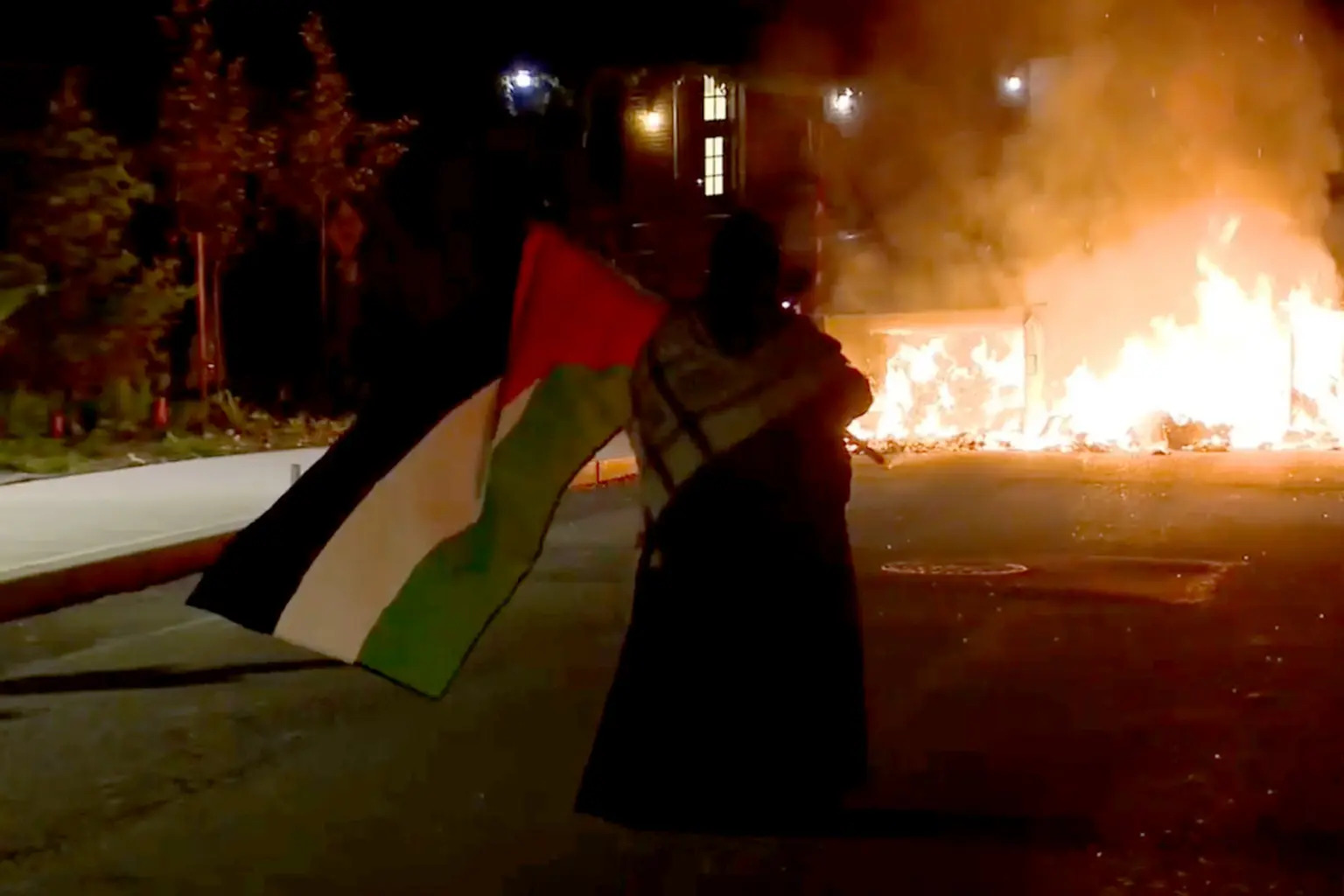
Late yesterday afternoon, a group identifying themselves as the suspended student organization SUPER UW posted on social media that they were occupying the Interdisciplinary Engineering Building [IEB] on the Seattle campus and asked for other groups to join them. These groups temporarily occupied and vandalized the building before being arrested by law enforcement officers from UWPD [University of Washington Police Department], the Seattle Police Department and the Washington State Patrol. They also set fire to dumpsters in a nearby street after blocking exits in the IEB and blocking nearby streets to delay firefighters’ access.
This was no peaceful protest in support of Palestinian rights or against the war in Gaza. I condemn this dangerous, violent and illegal building occupation and related vandalism. I also condemn in the strongest terms the group’s statement celebrating the Oct. 7, 2023, Hamas terrorist attacks against Israeli civilians. The University will not be intimidated by this sort of horrific and destructive behavior and will not engage in dialogue with any group using or condoning such destructive tactics. We will continue our actions to oppose antisemitism, racism and all forms of biases so that ALL our students, faculty, staff and visitors can feel safe and welcome on our campuses.
King County jail staff are working to identify the roughly 30 people who were arrested, so at the moment we do not know how many are UW students or community members. We are working with law enforcement and through our own disciplinary processes to ensure those responsible face appropriate consequences for their actions. And we will continue to stand strong against violent and illegal activities that create a hostile environment for any and all members of our community…”
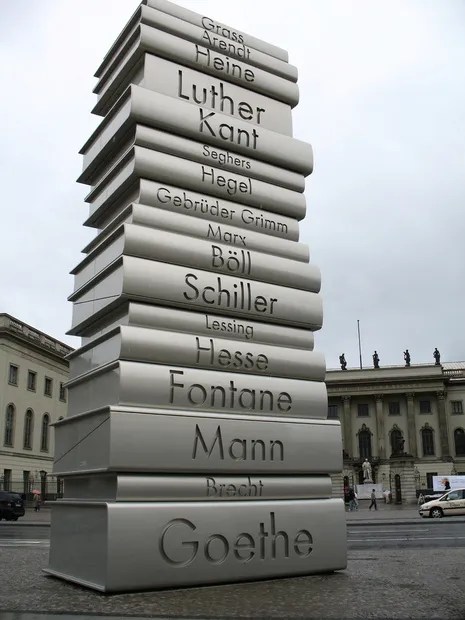
In the middle of this square on May 10, 1933, Nazi students burnt the works of hundreds of free authors, journalists, philosophers and scientists.
The words on a plaque at Bebelplatz in Berlin, Germany.
These arrest follow upon Trump’s action against foreign students taking part in increasingly violent pro-Palestinian protests on many American campuses. It was reported that over 1,000 students from about 160 colleges and universities had their visas cancelled since end March. The revocation of visas are made through the official powers assigned to Secretary of State Marco Rubio.
In the background, Harvard University is also facing not only cancellation of its tax exempt status by the Trump administration but has been awarded a US$2.2 billion termination in grants as legal battles escalate over the Ivy League school’s continued failure to stand up to rife antisemitism. It was reported that the NIH (National Institutes of Health) director for extramural research Michelle Bulls sent a letter on May 6 to Harvard president Alan Garber announcing the withdrawal of funds, stating that billions of dollars were not deployed “to benefit the American people and improve their quality of life,” and that Harvard was guilty of “widespread abuse of Jewish and Israeli students” by campus protesters; and that the institution “continues to engage in race discrimination including in its admissions process.” This is an endemic problem in some of the most prestigious American academic institutes of higher learning.
As a result, the Trump administration has rightly revoked Harvard’s ability to have foreign students for academic year 2025-26; this has been implemented by the Department of Homeland Security (DHS). This issue is also related to Harvard’s non-compliance in revealing who its donors are which may include radical foreign groups and the Chinese Communist Party, who are said to regard the US as an enemy. DHS Secretary Kristi Noem says the revocation will be cancelled if Harvard meets these conditions in 72 hours:
1. Any and all records, whether official or informal, in the possession of Harvard University, including electronic records and audio or video footage, regarding illegal activity whether on or off campus, by a nonimmigrant student enrolled in Harvard University in the last five years.
2. Any and all records, whether official or informal, in the possession of Harvard University, including electronic records and audio or video footage, regarding dangerous or violent activity whether on or off campus, by a nonimmigrant student enrolled in Harvard University in the last five years.
3. Any and all records, whether official or informal, in the possession of Harvard University, including electronic records and audio or video footage, regarding threats to other students or university personnel whether on or off campus, by a nonimmigrant student enrolled in Harvard University in the last five years.
4. Any and all records, whether official or informal, in the possession of Harvard University, including electronic records and audio or video footage, regarding deprivation of rights of other classmates or university personnel whether on or off campus, by a nonimmigrant student enrolled in Harvard University in the last five years.
5. Any and all disciplinary records of all nonimmigrant students enrolled in Harvard University in the last five years.
6. Any and all audio or video footage, in the possession of Harvard University, of any protest activity involving a nonimmigrant student on a Harvard University campus in the last five years.
These protests and rioting that have been going on in recent years, the rampant antisemitism on American campuses, go beyond the potential danger of targetting Jewish students: who have expressed concern over what is taking place in their university. That is serious enough already. But there is an underlying issue running through them that adds gravity to a dire situation: the recent rioting is undergirded by what is in effect an assault on higher education; it is indeed a war against learning itself. What would be the purpose of forcibly occupying a library and terrorising fellow students preparing for exams? The Columbia incident is an outrageous disregard for books and what they stand for; it is an attack on knowledge, the process of education, wisdom, and respect for those who seek to learn; it is a testament to total sociopathic and psychopathic behaviour. It is difficult to deny that the choice of a library is a calculated onslaught upon civility, decency, a sense of humanity. How do such people, devoid of sympathy or empathy for their peers, ever succeed to gain the same for those they term ‘oppressed’? Is the suppression of the rights of others or potentially harming those who are not even a vague threat to you: a sign that those you claim to defend are worthy of support; or that you should be given a hearing?
That these protests have murderous implications outside campus ruckus’ have been verified with this recent incident:
Two Israeli embassy staff were killed in a shooting outside an event at the Capital Jewish Museum in Washington, DC, on Wednesday night, and a suspect is in custody, officials said.
A man and a woman were shot and killed in the area of 3rd and F streets in Northwest which is near the museum, an FBI field office and the US attorney’s office. They were a young couple about to be engaged to be married, the Israeli ambassador said.
Washington Metropolitan Police Chief Pamela Smith said a single suspect who was seen pacing outside the museum before the event was in custody. The suspect, tentatively identified as 30-year-old Elias Rodriguez, chanted ‘Free Palestine, Free Palestine,’ in custody, she said.
President Donald Trump condemned the shooting. ‘These horrible D.C. killings, based obviously on antisemitism, must end, NOW!’ he said in a message on Truth Social. ‘Hatred and Radicalism have no place in the USA.’
Tal Naim Cohen, a spokesperson for the Israeli embassy in Washington, said two of its staff members were shot ‘at close range’ while attending a Jewish event at the museum.
Homeland Security Secretary Kristi Noem said in a post on X:
‘We will bring this depraved perpetrator to justice.’
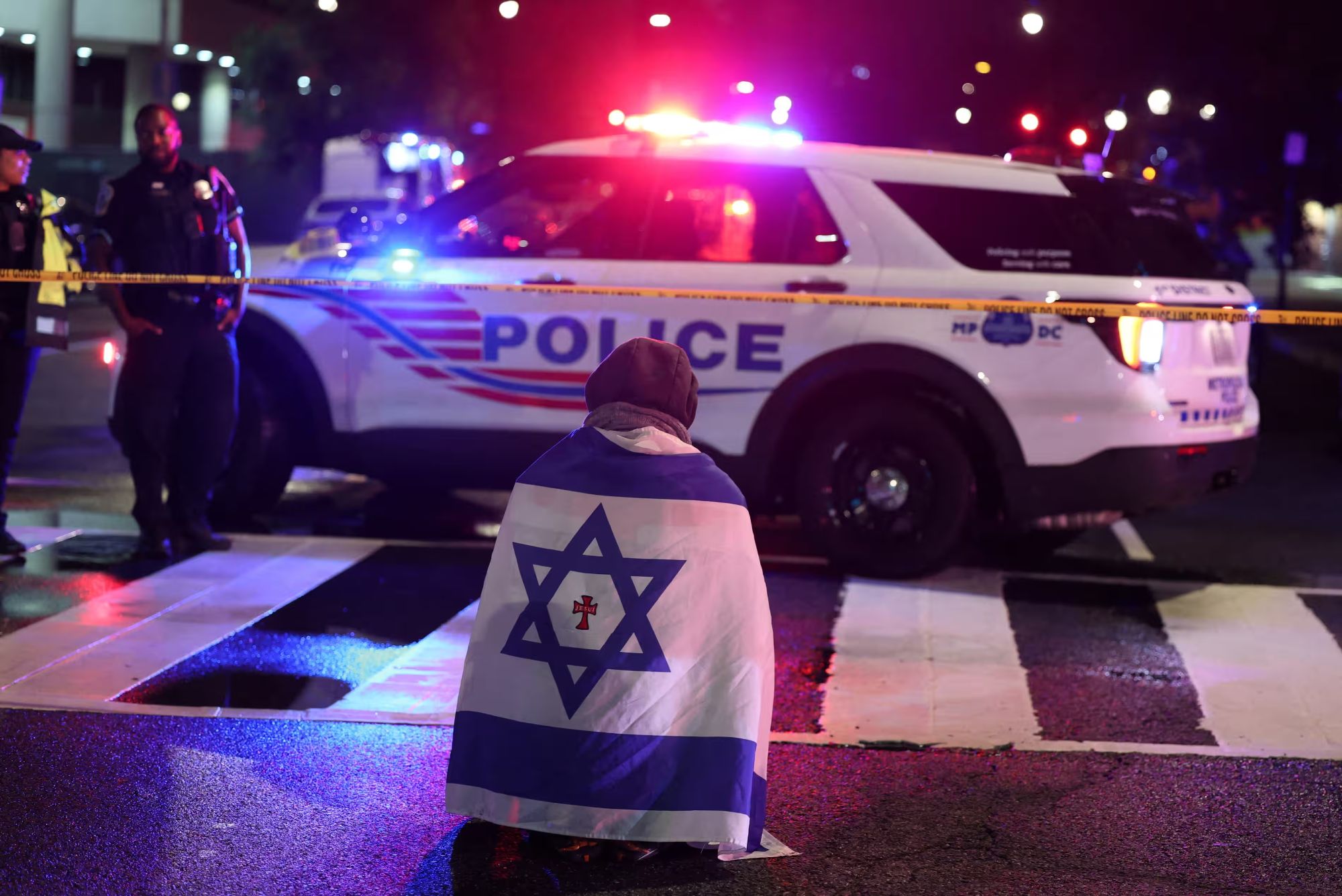
It was an assassination. Two staffers are dead; both worked for the Israeli Embassy. The ‘globalize the Intifada’ nutcases have answered that heinous call, the chant that’s been either indirectly endorsed or coddled by academia nationwide.
Matt Vespa, Senior Editor, Townhall.
This was but a prelude; where they burn books, they ultimately burn people.
Heinrich Heine (1797-1856).
Of course, the Palestinians who have been a pawn to power games between major international actors are deserving of great empathy, those who are subject to the wiles and arm-twisting of deadly entities like Hamas who are in turn manipulated by the ruthless. But do the brazen brats of CUAD and Super UW, case studies in immaturity, realise how insulting it is—to be given an extraordinary opportunity for education at (erstwhile) prestigious institutions—to Palestinian youth who rarely have such a chance in their lifetime? Instead of honouring learning, educating themselves and being a role model to those denied many privileges; instead of excelling in their studies, completing their schooling successfully, building their careers and doing volunteer work (in trouble spots), or form enterprises to help the underprivileged: these failed protesters garner suspensions, end up expelled, and in some instances, arrested. This is supposed to help the oppressed in other states? What about the oppressed in their own country, or do they not matter since they do not exist to the self-blinded? Perhaps none of this matters to the brainwashed. Cosplaying Arab resistance fighters in an American university full of sound and fury ultimately signifies nothing: but foolishness and wasted opportunity.
In so many cases, those who have signal professional achievements and have attained success in various fields partake in volunteer work among the underprivileged the world over. They do not have to indulge in violent protests and stall their course of study nor that of others (and ruin their peace of mind). Many such volunteers have firm spiritual grounding. The mindless aggression of wannabe ‘resistance heroes’ is a function of their nihilism: belief that violence is freedom, destruction is liberation; they have nothing to offer their society, their people, and the world but anger and hatred. Is this the lesson for Palestinian youth? Nihilism, anger, violence and hatred: and that leads to liberation? Then what? What are they qualified to build? Would they understand the value of learning, education, training, peace, or enterprise after being addicted to chants, slogans, and fighting? Will they eventually learn to focus on well being for themselves and others, learning to live and be appreciative of life instead of defining existence via self-destruction and the destruction of others? The death-driven agenda of the protests taking place in campuses cannot be overstated: it is not a celebration of life but the fervent desire to destroy another group designated as the ‘enemy’—this bears careful consideration for this is occurring in many societies.

Even now, it is the Trump Administration with some of the Arab world (at long last) who are trying to reconstruct and rebuild Gaza, provide proper homes, and give Palestinians a choice to live in other Arab lands. The US Democrats, who hardly seem to condemn violent student uprisings, are busy setting an example for disturbed youth with their latest stunt: trying to break into a Newark detention facility operated by the US Immigration and Customs Enforcement (ICE) which houses illegal immigrants charged with the worst crimes including brutalising children. This cannot be made up: a group of people including Democrat congressmen and the mayor tried to scuffle their way in to see these illegals; they were supposedly concerned how those allowed through unvetted entry across the border, by Joe Biden, were doing. These elected officials could have asked permission formally, as they knew and is the practice, to be allowed access (which was subsequently granted even to the media) to the facility. However, by trying to force their way, they created a situation that could have resulted in endangering not only the ICE officers but inmates especially if a riot broke out. The mayor was arrested, but his “misdemeanor charge of trespass” has since been dropped. However, the three Democrat members of congress (two women and a man) are being investigated for assaulting ICE officers; this has so far led to Congresswoman LaMonica McIver being charged for assault (as video footage indicates).
As US Department of Homeland Security Secretary Kristi Noem says:
‘Members of Congress should not break into detention centers or federal facilities…Had these members requested a tour, we certainly would have facilitated the tour.’
And as a Republican on the House’s homeland security panel states:
‘When you punch a law enforcement officer, that’s not the law enforcement officer’s fault. This behavior demands a swift and firm response, and I assure you action will be taken.’
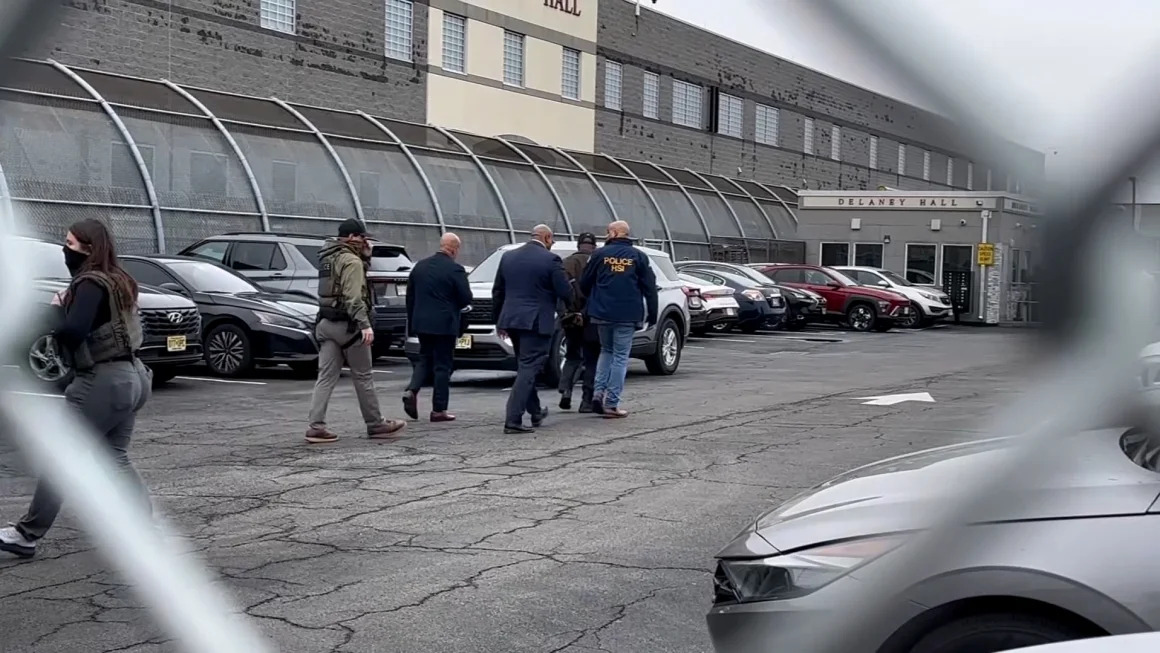
It is no wonder that when youth see melees and attempted violent takeovers by their elders, including elected representatives, as a response to what they dislike, disagree with, and basically hate—a negative reinforcement takes place in their malleable minds. At no point is there a peaceful response to trying to solve a difficulty by those much older: only recall the wanton destruction of Tesla showrooms and vehicles a few months ago. These protesting students and Democrats come across as domestic terrorists rather than those who care about others (the Democrats gatecrashing the ICE facility were not trying to break in to see US citizens but illegals: who did not vote for them nor pay their salaries).
The days of Woke are over…That woman was out of control. She was shoving federal agents. She was out of control. The days of that crap are over in this country. We’re going to have law and order.
Trump on Congresswoman LaMonica McIver.
Today my office has charged Congresswoman McIver with violation of Title 18, United States Code, Section 111(a)(1) for assaulting, impeding and interfering with law enforcement…No one is above the law—politicians or otherwise.
Alina Habba, US Attorney for the District of New Jersey.
In any case, the university offers—as teachers and members of the administration surely advocate—robust healthy discussion and debate of many matters, that is what higher education partly entails. But when the option to debate is thrust aside, and peaceful demonstrations shunned, and violence and ranting embraced: how does this lead to a positive outcome for anyone? That many campus administrations take a lackadaisical stand when such protestations spiral beyond the conscionable reflects their cowardice; that instructors and professors fail to take a stand against this, and at times encourage such misbehaviour or raucous expression of disagreement, is a sign of intellectual and moral failure on all counts and helps explains the Trump Administration’s tough stand against flabby Ivy League institutions and other colleges that favour the intellectual laziness of protestation rather than the rigour of academic discipline, and serious learning.
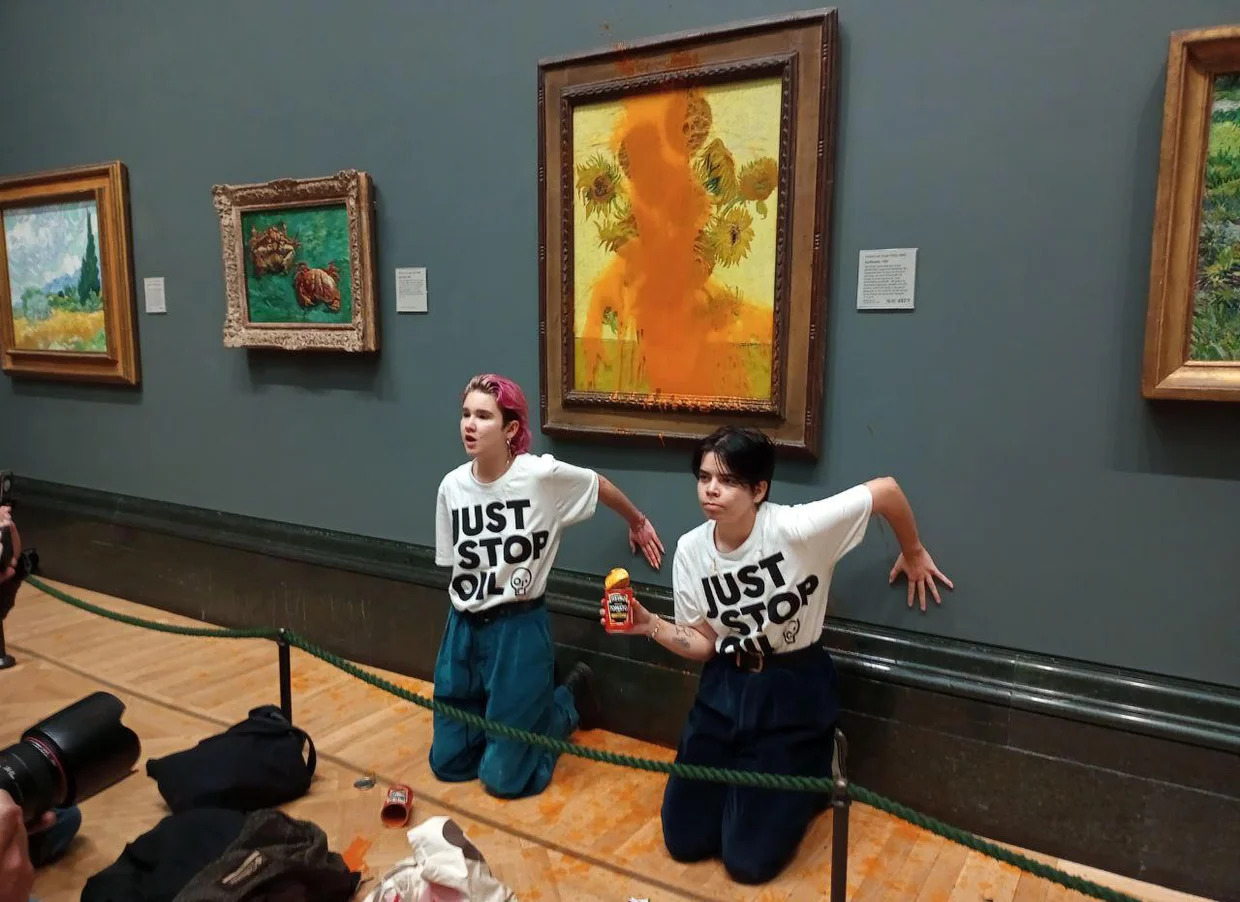
As in The Brutalist, the violation of the library and of university research buildings is tantamount not only to an assault on a person’s free spirit, the sanctity of human dignity in search of knowledge, betterment, and the humility to admit: we do not know everything and have to slowly and patiently acquire knowledge and wisdom; it is also like an attack on a human being. The desecration of the library is a brutalisation of a sense of beauty, that of intellectual grace. All the rioters symbolise, like the upside down image of the Statue of Liberty László Tóth encounters when he first sees America—everything that is ugly and pernicious. But this is not only an American phenomenon, it is a plague infecting youth in other parts of the world who think they are ‘saving’ the oppressed and the planet by acts of viciousness and boorishness. Witness the attempts to ruin artworks such as the “Mona Lisa”, which had soup thrown at it recently by ‘environmental protesters’, just as Van Gogh’s “Sunflowers” was similarly vandalised again by ‘environmental activists’: this mirrored what occurred in October 2022, when a pair flung contents from a couple of Heinz tomato soup cans over the painting at the London National Gallery; the duo then knelt before the artwork and glued their hands to the wall under the painting. They represent all that is against beauty and creative endeavour, and thrive on ugliness and the destructive; there is nothing life affirming in any of these activities. It does not matter that an artist’s work is damaged, or that countless people who love, study and practice art adore many artworks: what matters is that they think it should be ruined and no one else has the right to see or think otherwise, to show admiration or be passionate about grace and beauty. They set the agenda.
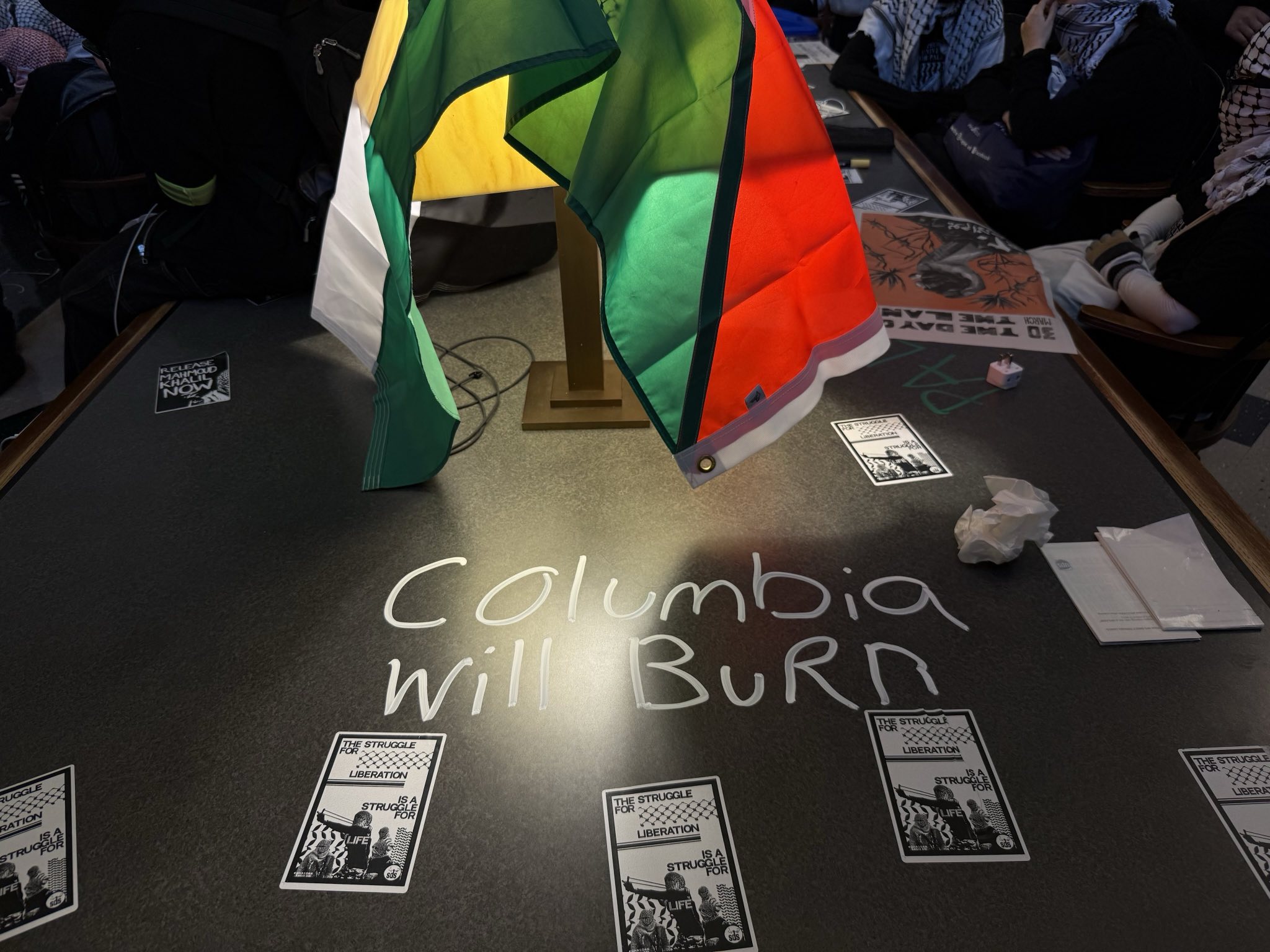
But the violation of the library in Columbia sent a genuinely chilling message with the words: “Columbia will burn” (above) sprayed on a desk meant for reading and study. This is but a step away from book burners taking over again. And if we ever learn from history, it is important to take note of Germany’s The Empty Library (1995) which is a memorial dedicated in remembrance to the Nazi book burnings at Berlin’s Bebelplatz, May 10, 1933. The memorial is emplaced within the cobblestoned plaza; the underground monument represents empty bookcases. At least 20,000 books, destroyed in a bonfire, were written principally by Jewish authors and those deemed as liberals and communists: such books were regarded subversive to Nazi ideology.
What is taking place in these acts of violence around campuses and against artworks in recent years are part of an ongoing conflict, it is part of what is termed hybrid warfare or the more advanced ‘fifth-generation warfare‘. It is a perpetual war that keeps society and youth, as in these instances, in a state of discombobulation: not only a state of confusion, but the inability to distinguish right from wrong, an obfuscation of what is law abiding and conspicuous disregard for the law. This is another facet of nihilism in that there is certainly an abrogation of any moral law, a championing of dystopia, the insistence on disharmony: what is recognised is the use of force, protest, and disruption to decide what should be done; it is in effect mob rule, it is an invitation to mayhem, it is in truth underwritten by chaos. This is what the acts of disregard for any sense of order, the celebration of criminality by trying to break into detention facilities represent; they have been reinforced by a former FBI director with a dubious reputation whose social media post instigated yet another assassination attempt on Trump—he was questioned by the US Secret Service, investigations are ongoing. He posited a preposterous theory that he did not know what his post implied. This is yet another example of dysfunction elders set for for youth[4].
Then there is the recent targetted bombing of a fertility clinic in Palm Springs, California. The car bombing was carried out by a young man who is said to have been killed in the blast. Four people were injured too but the reproductive materials were undamaged. As the FBI assistant director on the case says: “The subject had nihilistic ideations.” We are further told by the US Attorney for the Central District of California:
We can now confirm the identity of the suspect is Guy Edward Bartkus, 25, of 29 Palms. Bartkus is believed to be the individual who is deceased at the scene. Investigators are working to positively identify the remains. An anti pro-life manifesto believed to be authored by the suspect has been located and is being examined by the FBI. We are happy to report that no embryos at the IVF center were damaged by the explosion. This case is being treated as an intentional act of domestic terrorism. The investigation is ongoing.
In addition to being nihilistic…grievances expressed by violent offenders can also be ‘shallow, illogical and nonsensical, because they are a blending—a hodgepodge of different types of superficial information the offender found online or read about—in a very superficial way.’…They stitch together unrelated, unscientific, and often illogical ideas that simply appeal to them and bolster their justification for their lethal behavior.’
Former senior FBI profiler Dr. Mary Ellen O’Toole.
Furthermore, it is revealed that:
According to FBI research of past violent actors, nihilistic ideation refers to a ‘preoccupation with themes of violence, hopelessness, despair, pessimism, hatred, isolation, loneliness, or an “end-of-the-world” philosophy,’ said retired senior FBI profiler Dr. Mary Ellen O’Toole. ‘Nihilistic ideation is a very pessimistic view of the world.’…
Experts are quick to point out that trying to attach logic to heinous acts of violence is often an unsatisfying endeavor.
For example, O’Toole says the attacker’s suspected view about consent by the unborn ‘is not logical and has no basis in reality.’
In addition to being nihilistic, she said grievances expressed by violent offenders can also be ‘shallow, illogical and nonsensical, because they are a blending—a hodgepodge of different types of superficial information the offender found online or read about—in a very superficial way.’
O’Toole says, ‘most offenders who write manifestos do not conduct deep scientific dives into the information they use to create their personal themes or life-philosophies. They stitch together unrelated, unscientific, and often illogical ideas that simply appeal to them and bolster their justification for their lethal behavior.’

This trend of self-radicalised youth, individually or as a group, is part of a larger pattern of homegrown terrorists. They do not need to be on the frontlines elsewhere, they have created their zones of violence (confused as ‘liberation’) in their own town, and believe in nothing. What is it that they have to offer but the spectacle of violence and nihilism? This, importantly, represents the larger framework of the darkness these misguided youth and adults carry—hurled against light—the use of shouting against reason; the assertion and belief that by raising your voice and forcing your way and opinion you convince and are right; and by insinuating murder on social media and removing it, you abscond from responsibility. They contribute nothing positive except oppose anyone or anything that stands for reason, justice, decency and integrity because they are unable to discuss, debate, explain, convince through logic, persuade through common sense, win empathy through respect of others, or show humility or compassion; they are devoid of affection because they want people, things and places of learning and discovery to burn. Theirs is the creed of self-mutilation, the mutilation of all they despise: and that is almost anything many of us honour, respect and cherish. They deny free will, they refuse anyone the choice of disagreeing with them or appreciating anything that has positive value; you can only choose what they tell you to choose, they are totalitarians in the making. They believe hate is the answer. They are anti-life. They are anti-spiritual.
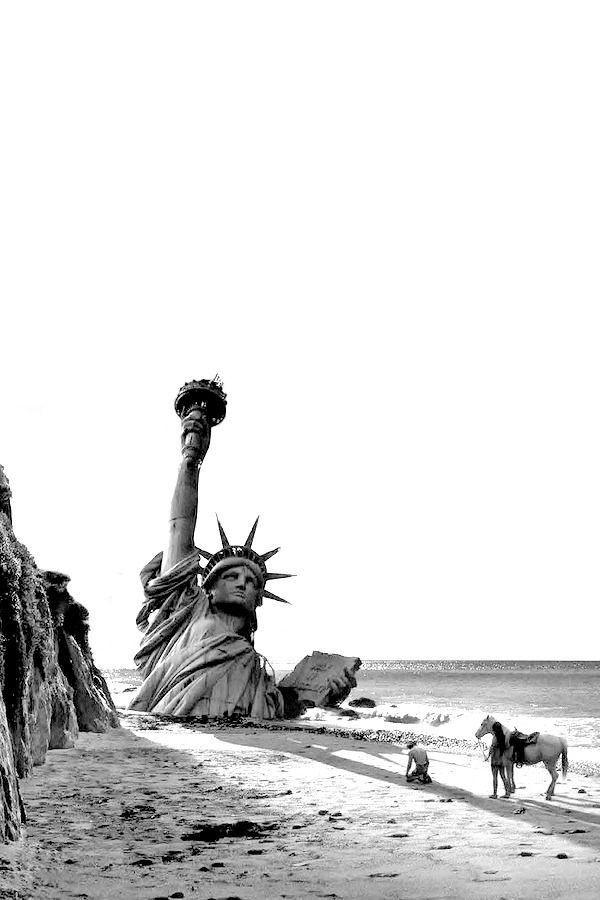
As in the iconic final scene of the classic 1968 film, Planet of the Apes, Charlton Heston is an astronaut brought to his knees in despair upon realising that what he took to be an alien planet he had landed on was, indeed, Earth in the future: as he discovers the remnants of the Statue of Liberty that survived a nuclear holocaust. Do people ever learn? Like the inverted image of the statue in The Brutalist, the ruined statue on the shores of what was America symbolises the perversion and destruction of liberty, and the freedom to build, create, and have a meaningful existence. The brutality of war and violence impacts both films. And this is manifest in Planet of the Apes in particular: it was released just after the 1967 Arab–Israeli War and during the height of the Vietnam War—the year of the film saw the launch of the Tet Offensive. The Cold War was going strong and with these conflicts clearly influenced, and reinforced the symbolism of that last scene. Interestingly, on closer examination, it will be noticed that the image of the statue in the poster of The Brutalist (above) is almost a mirror image of that in the final scene of Planet of the Apes: both are dismembered at the waist just below the Declaration of Independence—except that they are in reverse. The slab representing the Declaration is like a book, and the destruction of the statue carrying it is indicative of the desacralisation of light, liberty, and learning. The broken statues, right side up or upside down, embody ideals betrayed.
The time is approaching when a clear choice must be made, a stand taken to firmly turn the tide towards a more civilised society and world. The rejection of a return to a different form of the Dark Ages. If there is ever to be a Golden Age at all, those who are inverting common sense, moral consciousness, blaspheming against human dignity via uncivil disobedience, exhorting violence, disrespecting learning, appreciation and encouragement of art and scientific endeavour; those insisting with diabolical glee we live in their upside down world: must be shown—this will no longer be tolerated.
None are more hopelessly enslaved than those who falsely believe they are free.
Goethe.

End notes:
[1] Corbet’s film does have a dialogical relationship with Ayn Rand’s The Fountainhead. The film version, with Gary Cooper, is from 1949 and a product of post-WWII. There are images in the film that remind a viewer of what is seen in The Brutalist. The book is probably engaged even further by the latter. Megalopolis too has a dialogic connection to The Fountainhead.
[2] From Peter Eisenman’s site on the design of the Berlin Memorial to the murdered Jews of Europe:
This project manifests the instability inherent in what seems to be a system, here a rational grid, and its potential for dissolution in time. It suggests that when a supposedly rational and ordered system grows too large and out of proportion to its intended purpose, it loses touch with human reason. It then begins to reveal the innate disturbances and potential for chaos in all systems of apparent order.
The design begins from a rigid grid structure composed of 2,711 concrete pillars, or stelae, each 95 centimeters wide and 2.375 meters long, with heights varying from zero to 4 meters. The pillars are spaced 95 centimeters apart to allow only for individual passage through the grid. Each plane is determined by the intersections of the voids of the pillar grid and the gridlines of the larger context of Berlin. A slippage in the grid structure occurs, causing indeterminate spaces to develop. These spaces condense, narrow, and deepen to provide a multilayered experience from any point.
Remaining intact, however, is the idea that the pillars extend between two undulating grids. The way these two systems interact describes a zone of instability between them. These instabilities, or irregularities, are superimposed on both the topography of the site and on the top plane of the field of concrete pillars. A perceptual and conceptual divergence between the topography of the ground and the top plane of the stelae is thus created. It denotes a difference in time. The monument’s registration of this difference makes for a place of loss and contemplation, elements of memory.
In this monument there is no goal, no end, no working one’s way in or out. The duration of an individual’s experience of it grants no further understanding, since understanding the Holocaust is impossible. The time of the monument, its duration from top surface to ground, is disjoined from the time of experience. In this context, there is no nostalgia, no memory of the past, only the living memory of the individual experience.
[3] In contradistinction to the mayhem in the US, a different sort of ‘demonstration’, or rather petition, occurred when hundreds of books from the Yale-NUS liberal arts college which is closing down, were being discarded without any respect for their value or allowing students and others to take them:
Ms Avery Huang, 23, a Yale-NUS anthropology major who graduated in 2025 and was at the scene, said she tried to speak to NUS librarians to stop them. ‘I found it heartbreaking that these books, which are in perfectly good condition, are being thrown away.’
She added: ‘It boils down to how much they care about the books and the taxpayers’ money they’ve used and are now throwing away.’
The library in the former Yale-NUS campus is under the purview of NUS Libraries.
Ms Lee Jiaying, 21, who was part of Yale-NUS’ final batch of students, rushed down to the main entrance at 11.20am after getting a text and seeing photos of bags of books at the driveway.
‘These books were in brand-new, mostly untouched condition, on all kinds of popular fiction, non-fiction and academic genres,’ Ms Lee said, adding that she recognised some hardcover books that retail for more than SG$60 in the pile…
The disposal felt sudden and abrupt for students, Ms Lee said. ‘I felt heartbroken, seeing an unbelievable number of expensive books—many in near-perfect condition—being so carelessly discarded. It was painful to watch them thrown around like that.’
‘Books are precious educational resources for communities to enjoy. In the right hands, they could have been thoughtfully cared for,’ Ms Lee added. ‘I know many Singaporeans who put in great effort to salvage and give second-hand books a new home.
‘Yet today, it felt like an entire store’s worth of books was discarded out of administrative convenience. These books could have benefited those who cannot afford to buy them, members of the public who value shared resources and curious minds who would have deeply appreciated them.’…
One Yale-NUS alumna, who wanted to be known only as Ms Yin, said: ‘I feel that NUS, as a global leading institution, should be able to recognise the scarcity and preciousness of intellectual resources like books.
While there may have been issues of labour and manpower to, say, remove RFID chips on the book, I believe that we had a lot of students who were willing to volunteer their time to allow for some salvaging of books,’ the 26-year-old added.
Ms Kristina Gweneth Simundo, 23, who graduated from Yale-NUS in 2024, said she felt anger and grief at this ‘opaque and top-down decision’ by NUS. ‘When institutions destroy knowledge so casually, they signal a disturbing disregard for memory, inquiry and the future of learning itself.’

A consequence of the unhappiness over the disgraceful decision of wilfully disposing books in good condition:
Following the outcry, NUS issued an apology to the Yale-NUS community.
No public statement has been made. The New Paper has reached out to NUS for further comment.
In the meantime, the university said it would attempt to retrieve the discarded books from the recycling facility.
A book giveaway will also be held at the Yale-NUS library for the remaining titles that cannot be transferred to the NUS Central Library, including duplicates that were offered to other libraries but went unclaimed.
‘The books could have benefited those who can’t afford to buy them. They’re precious resources. In the right hands, they would have been deeply appreciated,’ said Ms Lee [Jiaying, 21, a student from the college’s final cohort].
As of this writing, it seems that some of the books have sadly been destroyed:
Alumni have asked for clarity on the number and financial value of the books that were disposed, and how many were successfully retrieved, as well as whether alternative methods of disposal were considered…
‘We express deep concern over the planned disposal of a significant number of academic materials that were in good condition,’ the petition said.
‘While efforts may be under way to retrieve these materials, the initial intent to dispose of them raises serious questions on the responsible use of money and resources, NUS’ commitment to sustainability, and the value placed on academic texts that have supported past students and may continue to benefit present students of NUS.’…
One Yale-NUS alumnus, who requested full anonymity, called Asia Recycling on the morning of May 21. He said the books are likely to have been already destroyed.
According to the alumnus, the employee of the recycling company said he had tried checking with Green Orange Enviro, the company that took the bags of books from Yale-NUS, because students had called him to check on the books.
The alumnus added that NUS did reach out to the recycling company to try to get the books back, but it was too late.

[4] From The New York Times:
In an interview with Bret Baier of Fox News that was broadcast on Friday, Mr. Trump—the target of two assassination attempts last year—said he believed that Mr. Comey was calling for him to be killed.
‘He knew exactly what that meant,’ Mr. Trump said. ‘A child knows what that meant. If you’re the F.B.I. director and you don’t know what that meant, that meant assassination. And it says it loud and clear.’
Asked what should happen to Mr. Comey, Mr. Trump replied that it should be up to Attorney General Pam Bondi.
‘But I will say this, I think it’s a terrible thing,’ Mr. Trump continued. ‘And when you add his history to that, if he had a clean history, he doesn’t. He’s a dirty cop, he’s a dirty cop. And if he had a clean history, I could understand if there was a leniency, but I’m going to let them make that decision.’
The writer is the founding editor of Philosophers for Change.
If publishing or re-posting this article kindly use the entire piece, credit the writer and this website: Philosophers for Change, philosophersforchange.org. Thanks for your support.
This work is licensed under a Creative Commons Attribution-NonCommercial-NoDerivs 4.0 International.
[Featured picture: Alternative Movie Posters; top picture credit: Official poster.]

 Philosophers for Change